 |
||
 |
|
|
Revolutionary Tennis |
||
|
|
|
Tennis Instruction That Makes Sense |
||
|
|
|
|
||
|
|
|
How To Apply Step 4
Your Body's Power
Any movement to a ball angling away from you causes you to turn, even if you move parallel to the baseline, which you shouldn't. But if you turn first (to take the racket back or to load the muscles), you're turning away from the ball, which makes it more difficult to move into it.
Learning to shift your weight straight at and into the ball is difficult at first because you will try to do too much. Again, less is more. You don't have to shift a lot of weight to empower the racket because the ball is light and rubbery, the racket acts as a trampoline, the playing field is small, and you're strong to begin with. The length of the swing is much more than the length, or amount of, body weight shift. The speed of the swing (acceleration) is infinitely faster than the transferring of body weight. Body weight transfer is little when compared to stroke length and input, just like in any other endeavor. Stand upright when you move to the ball, don't lean over. Lean back, if you have to. The "pop" on the ball comes first by projecting your body weight into the contact spot linearly followed by a timely swing, not by rotating the body around during the swing. SHIFT LITTLE, SWING FREELY Shift little, swing freely. The swing comes through freely like a swing swinging to and fro. Your body remains still, like the legs on the swing set, to allow this to happen. Don't swing so darn much your body moves around while doing it. FOR ADVANCED PLAYERS Upper body flexibility to turn your torso a little bit without also turning the hips ('cause they're going forward into the ball) is a given if you want to improve. I remember practicing moving forward into the ball while turning the upper torso at the same time. How? From the ready position, I'd take my racket back on either side, turn my upper body away from the net while keeping the lower body and my own face facing the net, and I would walk straight to the net this way. Time and time again. You need to be able to loosen up, or separate, the torso from the hips so it can turn independently and not affect the hips. I'm surprised how much more flexible I am than my students when I demonstrate this, which I guess is par for the course. Yoga, doing the carioca step endlessly, or simply walking while turning the torso are the three ways to achieve this flexibility. |
||
|
|
|
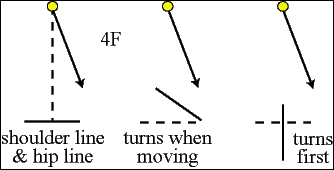
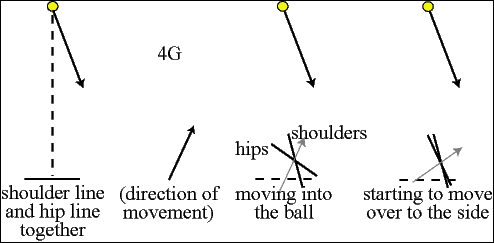 As long as your hips and feet (your body center) lead you into the ball you can rotate the upper body as much as you want when taking the racket back because if you indeed move into the ball there will be a natural limit on that rotation. If you allow your hips (body center) to turn more because the upper body turns more, you'll find yourself and your momentum no longer moving into the ball but away from it. And you never have enough time or energy to zig first then zag into the ball.
|
||||||||||||||||||||||||||||||||||||||||||||||||||||||||||||||
|
|
|
||||||||||||||||||||||||||||||||||||||||||||||||||||||||||||
























