 |
||
 |
|
|
Revolutionary Tennis |
||
|
|
|
Tennis Instruction That Makes Sense |
||
|
|
|
|
||
|
|
|
Step 10 The Volley (sweet thing) Turn First? Nope It's A Fact Rax Distortion Move First Stroke Preparation TIME AND SPACE, THE FINAL FRONTIER THESE ARE THE VOYAGES OF THE TENNIS VOLLEY Established volley technique is nothing short of bigotry. And foolishness. You turn the shoulders, you keep the racket head above the hand or at a 90 degree angle to the wrist, you take one step, lock the wrist, hit out in front and slice down on the ball. Foolishness, all of it.
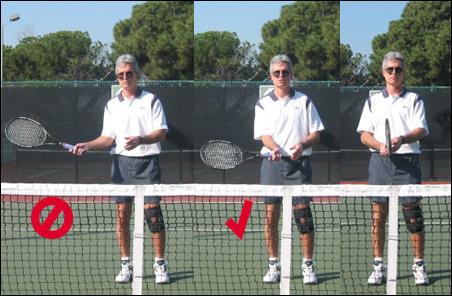
The established ready position is on the far right, the racket face is held cocked up above the hand and in front of your face. From here you can adjust one step down to get the medium ball, yes, but two steps to get the lower ball. Since most balls are going to be struck lower than the racket face in this ready position, why start with it so dang high? Furthermore, it can be distracting with the racket at eye level. And if you're thinking you should start this way since the volley needs to be hit with the racket head cocked above your wrist to form a letter "V" or a 90 degree angle there's more coming to show you why that's foolishness. Say "buh-bye!" to the letter "V," to a 90 degree angle, to getting down on the low volley, to stroking high to low, to locking your wrist, hitting out in front, extending, and turning the shoulders.
You're in the ready position. What's the first thing you do, prepare the stroke or move first? You move first. If you move first your instincts will start calculating your space and time and contact issues for you better than if you were standing still "taking the racket back," and no one stands still at the baseline taking the racket back first. You do not prepare the stroke first, which means you do not turn the shoulders first. Gotta move.
Luckily up at the net when you move you're not moving to cover distance as you do on groundstrokes. When you're up at the net:
FACT MOST-O IMPORTANTE: BALL'S ALWAYS CLOSER
Second thing on your mind is: You're going to take 2 steps. If you (pivot and) take one step to hit the ball you must be a Pirate with a wooden leg, Yo Ho! or your pro is. Movement starts your brain's process of figuring out where, when, and how you're going to hit the ball, you can't figure this out by standing still, unless you play golf, and golfers need a lot of help. 2 steps lets the brain calculate best.
The volley has three parts, psychology, technique, and art. The first two we butcher when talking about it. Art?
FACT MOST IMPORTANTE TOO: RACKET DISTORTION At contact the racket face opens and drops down, or wobbles, just like on groundstrokes, serves, everything else. The racket face distorts, it's called equal and opposite reaction of ball onto racket. All other strokes have a (backswing and a) forward swing that creates momentum to counter (but not overcome) this distortion but a volley does not have this counter momentum because it does not swing back or forward. A volley never has this counter momentum but sadly the tennis establishment teaches a high-to-low volley stroke to develop some counter momentum. That's like saying h-o-old onto the steering wheel with both hands driving the highway because your car's front end alignment is off. Align the wheels of your car, align the racket's forward stroke better into the ball (more upcoming). Example: Your tennis teacher wants to show how you don't have to swing at a volley to make the ball go over the net. You're standing up at the net simulating a volley contact spot with the racket out in front of you and the teacher throws a ball hard into your racket face and asks you not to swing. What happens? The ball bounces up off the racket and over the net on its own without the racket moving into the ball. Lost in this familiar example is how the racket face bounces back and down. Even if you gently drop the ball onto the racket face the same thing occurs - the racket face bounces back and down - though not as pronounced. This distortion on the racket face is undeniable in all strokes but it is the key to understanding how-to hit a volley. Your priority is going to be to work with this reality and not think about "hitting" the ball as you do for all other strokes. FACT: TIME AND SPACE I know you feel you have less time in which to react to a ball when you're up at the net and that you have less court space in which to hit your return, yet while this may literally be true this isn't reality. There is enough time and space for you to do your thing. Don't freak out ahead of time. It's like everything else, once you learn, or know how to do it, you realize it's not that hard to do. FACT: THE VOLLEY IS AN ORPHAN A groundstroke is hit in response to an opponent's groundstroke, you take what's coming at you and send it back in the same way. A return is a response to a serve, an overhead to a lob. An approach shot is a response to a weak groundstroke, but a volley is not a response to another volley. A volley responds to a groundstroke, yes, but the volley reinterprets what came at it. It takes the groundstroke and changes it into something else: the beginning of the Volley As Art idea, that of reinterpretation. This helps explain why you have trouble exchanging volleys at the net in doubles, you're expecting, wanting, a groundstroke to hit against, and when it's a volley coming at you it's tough to hit a volley in return (you either whack it or fail to hit a good one). THE GRIP Plenty of other sites explain the volley grip and I won't here. It's basically in between a forehand and backhand groundstroke grip, it's an open face on both sides to lift the ball, and you use one grip. If you're changing grips and you want to improve, graduate and use one grip. By the same token you can still play if you just have to change grips, but no complaints, please.
MOVE FIRST, PUH-LEASE If you "prepare" your stroke first by turning the shoulders and reaching out to the side you are telling your instincts you are prepared to hit the ball with this amount of lateral reach. Either you'll move just enough to r-e-ach for the ball, or you'll back away from the ball to keep that lateral reach you prepared for. Don't retrofit your body to satisfy your stroke, a common theme in Revolutionary Tennis, and remember the first volley fact is the ball won't be wide from you so don't expect to re-each out w-i-de for it. MOVEMENT REALITIES Take 2 steps to hit the volley, not 1 step into the ball with the front foot, which is a lack of rhythm. Revolutionary Tennis offers how rhythm from body and feet feeds and leads into good stroke production, meaning the minimum number of steps for this is 2. And forward, not ever parallel to the net.
You move the back foot first, then finish with the front foot. Yes, there is enough time to do this, and you most likely are doing it unless you try to be a good student and take only one step with your front foot - which is why your volley is not-a-good. Tiny steps here at times. You don't have to put that second step down before contact. You can step down with the second step after contact, just as long as the second step was on its way. This area is finally being acknowledged by the tennis establishment, that is step-hit-step, yet the larger picture that it is two steps that forms this reality is missing from their tennis brain - or do they want you to step into the ball with the front foot and then do the second step (step-hit-step) with the back foot? Doubt it.
STROKE PREPARATION ... MUSCLE MEMORY You're gonna move first, remember, but to develop the right kind of muscle memory for stroke preparation let's go back to the ready position. Due to the fact the ball's always closer to you laterally than at any other time, stroke preparation is small and minimal because the ball's going to be close to you. The stroke can expand easily if the ball's a little farther away, but not the other way around. The closest volleys are the hardest to hit, right? And backhands have no strength? Time to end all this nonsense. F/H PREPARATION A forehand volley is tennis' one unnatural stroke. It requires an open racket face, no wrist, and no pronation. If you don't move the racket and arm out laterally to the side, or turn the shoulders, how do you prepare? Only the hand moves the racket face to the side, either up, waist high, or low, depending on the eventual contact spot. The arm does not, ought not, move to the side. You first prepare the stroke, you are not yet reaching out to hit the ball. This is how you make the smallest lateral move with the racket face so you can then reach out to the ball (remember the ball's always going to be closer to you laterally than on a groundstroke). It's a lot easier and simpler to expand the stroke as needed to reach the ball than to pull the arm in (or step back, or slow down, or stop moving) if you prepare with the racket extended out to your side. Don't overplay your hand from the get-go.
The elbow tries to remain in front of the body as if it were holding a tennis ball against the front of your body/hip. This is awkward, but the idea that the elbow is in front of the body/hip for contact is the same for a forehand groundstroke. It's easier on a groundstroke because you get to swing, it's harder on a volley to place the elbow and arm in this position from the get-go. [Of course on a pro's slow motion replay you'll see his/her racket face go back, but we're all trying "not to do that" and instead are trying to achieve contact with the elbow out in front and the arm bent for flexibility and leverage.]
THE WRIST LAYS BACK ON A F/H Preparing the volley on a f/h means the wrist lays back. And to calm down dear old Vic Braden, just because the wrist lays back does NOT mean you're doing this "in order to snap the wrist into the ball." The sky isn't falling, Vic, with this maneuver. You will lay the wrist back and it remains relatively fixed. Although you know the wrist still moves on a volley to absorb and counter the impact...hee, hee...or else the racket face would really blow out backwards. But I promise not to talk about that. The idea that the wrist remains locked and fixed like a brick wall is misleading What locks and remains fixed and immovable like a brick wall is... your hand on the racket handle. Your fingers, your palm, on a backhand the back of the hand and fingers. You don't have a death grip on the handle, no, but your palm, and fingers, and hand need to resist the impact, the wrist works with the impact. The wrist is the hand's source of strength, it supports the hand. The racket is not connected at the wrist. The hand can be strong during the impact only if the wrist flexes its muscle, and if it is flexing it is not literally fixed or locked. The wrist acts as a shock absorber and not a brick wall. B/H PREPARATION
Carry the weight of the racket in the off hand, and let the off hand prepare the racket face waist high. Turn the chest to face the contact spot, slightly to your one side, and try to curl the front shoulder to first give your upper arm more strength (then forearm, wrist and hand). Assuming, of course, the shoulder remains motionless during the volley. Remember that movement into the ball (and hitting on time) yields stroke strength, the arm's strength does not do this. If you "turn" one or both shoulders for the backhand volley you are not moving first. Strengthen the wrist and allow it to remain flexible. The wrist is going to deflect on a b/h even more during the contact so allow it to. That is, work with it, don't try to make it ab-solute-ly locked 'cause that'll lock up your arm and then you're stiff, lose leverage, and it gets ugly. There is just no way your wrist, or mine, can be locked solid on a volley, a backhand in particular. A forehand has a better chance, though it won't be 100%.
Prevent the front elbow from lifting outward or pointing to the net before, during, or after hitting.
"V" IS FOR VICTORY, NOT VOLLEYS The famous "V" shape or 90 degree angle that celebrity teachers point to is foolishness. The "V" angle between the side of your hand (base of thumb) and the side of your forearm is not fixed due to the volley realities stated earlier of a leveraged arm and three contact heights. Furthermore, there's another, second, "V" angle formed between the wrist laying back (back of the hand) and the outer flat part of your forearm. Neither "V" remains fixed. That a "V" exists is true, establishmentarians, but it's a flexible affair, not fixed, and there's two of them, not one. Dr. Jack Groppel, a self described sport scientist who grew up playing Little League and not tennis, writes in his "High Tech Tennis" book that the "V" is his more insightful recognition of volley success than an earlier "myth" of keeping the racket head cocked above your wrist when volleying. He writes, "The racket head can even be positioned below your wrist with the same wrist angle as when held above your wrist. Therefore, key your playing on the wrist angle and not necessarily on the racket head position." Sounds like another way of saying the same thing. But is this true? Can "The racket head...be positioned below your wrist with the same wrist angle as when held above your wrist"? You be the judge. The photos illustrate the "V" on the volley if the racket head is positioned below your wrist with the same wrist angle, "about 90 degrees" like Groppel opines, as when held above your wrist. I taped a ruler to my racket to maintain and illustrate just what, in Groppel's words, "maintaining a consistent angle between wrist and racket shaft whatever the level of the ball" really would look like on a variety of shots. The first photo on the left is fine, both f/h and b/h versions, but the leverage realities of the arm deteriorate with each successive photo where I strive to maintain a consistent angle between racket shaft and wrist.
Getting down as low as Pat Cash for a volley is impossible, and that's not why he won Wimbledon. The fact that it takes a man as strong as Pat to volley "correctly" per the establishmentarians should be a sign that maybe their understanding and concepts are a little medieval.
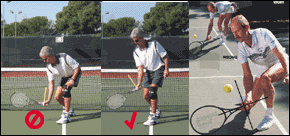
Stan Smith's low how-to photo clearly shows a wrist to racket shaft angle not close to being "about 90 degrees," and the greatest talent at the net, McEnroe, shows this as well. Photo right is me getting the racket head down low a better way, the ruler shows no "V" per the academics.
Of course when you learn to volley in this new way, that is you allow your hand/wrist to relax down, let the racket head drop, the ball is going to pop up off the strings and go out, assuming your posture is good. You're going to have to get used to not stepping on the gas pedal while simultaneously braking, which is the old fashioned way of locking everything but extending and punching down hard on the ball. Once you get the hang of increasing your stroke's leverage by making better use of your arm's leverage technique you will be working less for your result: the ball comes up better and goes deeper, with less effort. A shortstop keeps the webbing of the glove above his wrist to snag a ball chest high, tilts it to his side and below his wrist for lower balls. Shortstops don't get down and keep the webbing up on a low ball. Our racket face is our glove, not the racket handle. I've included one of Groppel's earlier articles on this 90 degree foolishness of wrist to racket. First it was the "V," that is keep the racket head above the wrist on all volleys, and now it's not that, no, it's, it's, it's... keep things at a 90 degree angle. It reminds me how medieval astronomers added sub-spheres to their main theory of how the universe revolved around a stationary earth to help reconcile inconsistencies they were unwilling to attribute to what was a flawed theory in the first place. Groppel's a nice guy, from the Midwest, but with a bachelor's degree in wildlife biology (and later Phys Ed and Biomechanics degrees) it's clear tennis was not, and is not, his talent. This whole idea of a fixed relationship between wrist and racket is ludicrous, no wonder our juniors can't volley their way out of a paper bag, they attend tennis academies influenced by the likes of Groppel, et. al., who preach this dogma. All that's missing is a non-profit tennis academy and they'll be tax exempt. Just why are these alleged "tennis scientists" taking over tennis teaching? None of them plays better than a high school doubles player, none toured as a junior even. Just why have we allowed "tennis scientists" to hijack the game? Time to get off my soap box. THE WRIST The wrist first relaxes to prepare the racket up, medium, or low while laying back. Then right away it stops relaxing and firms up to load strength into your hand. The wrist acts like a shock absorber here and recoils and moves to provide strength to the hand so the hand (and not the wrist) can be firm like a brick wall. The wrist should not break in any traditional or non traditional way, it still remains in a cocked position after the f/h, unlike Groppel's disingenuous version upcoming. On a backhand the wrist shouldn't go backward or forward. In both f/h and b/h you'll notice the wrist isn't supposed to move even after contact, but in reality you, consciously or subconsciously, will move it to counter the opposite effect of the ball hitting against the racket. You break it on the f/h, flick it on the b/h. Big no-no. Perhaps this is why establishmentarians try to teach the driving volley, this swing-like volley masks a breaking or flicking wrist. The solution lies in steeling yourself into keeping your hand firm - your hand firm - prior to contact, through contact, and after contact.
STAND UP TO THE BALL
Stand well, balance well, keep your torso back. Trust, or learn, how your body supports your stroke and how vision and your body's sensing mechanisms, not conscious thought, are responsible for timing. The stroke does not do it all, not even half of it. Your body does, your body as a whole kinesthetically provides the data your brain needs to calculate the execution sets it sends back to your body to interpret and act upon.
HERE COMES DA FUZZ Don't move your head laterally to track the ball, just let the eyes track any lateral movement. This keeps your head still, your torso back, and helps you time the ball. Why? Again, the first fact about being up at the net: the ball's not going to be very wide from you. Up at the net players too often turn their head to the side right away and immediately they're telling their brain they're going to hit the ball later than they ought to, or they're too aggressive and bend over, similarly giving their brain the wrong contact coordinates. Since volleys require greater timing you need less gross body movement of all types. COUNTER RACKET DISTORTION The ball's going to distort your racket face, remember. Expect this distortion and work with it, work through it. Firm up your hand, strengthen the wrist, and allow for some wrist flexibility during the hit. Continue working through the hit to keep the racket up/prevent the racket from going down. Only control freaks expect their wrist to be as solid as a brick wall during contact, so if you're not one let go of this idea.
THE CONTACT SPOT - LEVEL, OR LOW TO HIGH You take the contact spot as you can get it, high, medium, low, in tight, out wide, fast, slow, early, later, off center, off balance, confusing, whatever. You can't expect to always have the racket at just the same height with regard to the hand and out in front just the same way to hit with just the same spin all the time. You can't be anal up at the net.
Roll the mouse over the racket and ball flight image. Hit level to lift the ball, or a very gentle low to high. What's the problem with that? You're up at the net, place an open racket face below the ball and allow it to bounce UP off the strings. Prevent the racket face from dipping down on contact, lift the ball above its contact spot. Every stroke lifts the ball above its contact spot, volleys are no different. A high-to-low motion imparts a lot of back spin on the ball and can lift the ball up and high over the water hazard - this is tennis! A lot of back spin executed on a wooden or grass tennis court, where tennis began, makes the ball squirt on the bounce. But on today's surfaces that ball sits up, it doesn't move forward much on the bounce. Certainly professional athletes can at times cut at the ball on their volley and the ball stays down, but just how many players have good volleys nowadays? Gently low to high, or at least hit level through the ball. STROKE PATH As with groundstrokes the contact path line is outside in, the arm compresses and gets closer to the body (unless you choose to hit inside out). I know you're told to go out and extend the racket away from you either in front toward the net or out to the side with the arm, but, then again, your volley's not-a-good, right? OUT IN FRONT
The arm is a leveraging device, it acts as a spring, if you will. If you straighten your arm to then hit the ball you will have literally sprung your spring and the volley is impotent. It's common to find the magazine or web site pro advocating straightening the arm on a backhand volley. Yeech. Similar to a groundstroke, the arm is bent and unbends for contact, though in minimalist manner.
The left photo of Jack Groppel on the left shows the arm too straight and hitting too far out in front and away from his body laterally for a successful volley.
Groppel is answering a question here in the USPTA magazine on whether a volley's racket head rotates before impact. He says "No racquet head rotation occurs [on high-speed film] immediately prior to or during impact. However, after the ball is struck, the racquet head often is seen to rotate toward a more slanted position [i.e., open]." He certainly doesn't show that with his straight arm and wrist flex in the second photo. This is a prime example of how the self-described cognoscenti will look at information on the tree of knowledge but are unable to put it all together because they either lack real tennis playing experience or haven't been told or been able to read how to put it all together. He glosses over one of the two major facts uncovered here by Revolutionary Tennis that help explain how to volley, namely racket face distortion on impact. The racket face opens and goes backwards, as mentioned above in Fact Most Importante Too: Racket Distortion. Understanding this inevitability and working with it instead of against it would give Groppel a far different and better looking finish on his volley, and a more effective result: racket held at an angle and not perpendicular to the net, arm not straightening.
VOLLEY PSYCHOLOGY You have to subjugate your ego when you're up at the net. You have to be willing to win the point with the scalpel instead of the ax. There is no such thing as a put-away volley, only the opportunity to win the point. And if the opportunity isn't there, then you control the point and take the opportunity away from your opponent so you can hit a second volley. There is no such thing as a driving volley, only the rare opportunity to hit one solidly because it's above the net - there's no swing to a volley. Win without the big bang, don't be afraid to be up at the net, invite the opponent to hit at you. When up at the net you can't be afraid of losing the point, or of looking bad, or of being passed, or of being hit with the tennis ball. It's normal. If you're up at the net you want the ball to be hit at you because you'll have a better chance to reach it. Think about it. Bring it on!
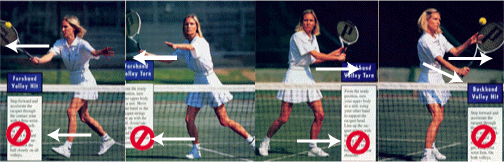
The above photos come from TENNIS magazine's "Complete guide to the basics of the game" supplement, photos by Caryn Levy. Each photo, you can now see, is seriously flawed. The interior photos represent the first movement up at the net. Not so bad that she's moving, but she's moving parallel to the net, she's turned her body away from the ball - considering she will try to step forward. She opens up the stroke far too wide from her body, moves across markedly on the f/h while extending out to the side with the stroke, and on the b/h while not stepping wide as on the f/h she's straightening her arm down while also extending out to the side. Her arm has no leverage on either side. For both contact spots her head is turned way too much. The magazine wanted to charge you $1.00 each for additional copies. No wonder your volley is not-a-good and tennis hungers for players.
VOLLEY AS ART - SWEET THING The missing ingredient in "how to" hit a volley lies in understanding that the volley is art. The stroke is a reinterpretation of a groundstroke. Punching is too violent and active a term to describe the volley's execution. You are holding a mirror to the ball and reflecting it. Placement works per Step 7, that is if you are on time you go crosscourt, if later down the line, for the most part. If the ball sits up, is not struck hard, and you are up close to the net, you can put it just about where you'd like to. John McEnroe expresses this point the best, and Rod Laver is a close second. Pancho Gonzalez was a strong stud with style, Jack Kramer was strong but dull, Don Budge had a flowing grace. Gregg Rudzeski has one gear, Tim Henman has his heart in the right place but something's missing. I suspect Bill Tilden had a wonderful volley even though he "got down" like he didn't have to. The volley reflects the player's personality. McEnroe's been called the artist, and Laver had talent, plus a wonderful forearm and wrist.
Taylor Dent here, in black and white to the left, is trying to do his best per what he's been taught. The hand is down, the racket head up, or you can say the wrist is at about 90 degrees to the racket shaft, and the arm needs to straighten for these requirements. Since the ball is slightly above his navel it's clear this isn't the strongest configuration for the hand/arm that holds a 27 inch extension known as a tennis racket. Taylor's a strong guy and he makes this work, though he'd be the first to tell you he's not terribly consistent with that b/h volley. The color photo in the middle is a reasonable copy of Dent's shot. The ruler taped to the racket handle indicates I'm maintaining 90 degrees. The white net tape behind the racket matches well with the photo on the far right to show virtually the same contact height. On the far right I am not getting down as much but instead opt to stand up for better posture, thus better strength into my arm and hand. My wrist is not in a cocked position and the racket face indeed becomes an extension of my hand (and its strength). You may have seen photos of McEnroe's b/h volley with his arm bent like this. There is a better way. You don't need to have the personality of an artist to volley well. But you need to be humble and calm when you're up at the net, you need to be willing to fall flat on your face with your effort and still feel cool about yourself. And you simply can not try to impress anyone up there. No Charlie the Tuna's here, please. I use a lot of the older players as examples because today's players simply don't know what to do at the net. And is it a coincidence, then, that tennis critics say today's players lack personality? Vincent Van Gogh looked at the landscape and reflected it in his own design, he had something very special inside him. You're not going to be a great artist like Van Gogh, or be as original. It's not necessary, this is tennis after all. Remember taking art class and how difficult it was trying to draw, or paint? And the teacher asked you to slow down, to take your time, and to try to get it from the inside? Same for volleys. You simply aren't going to have the kind of volley you want if you stick your arm out there, if you muscle the ball, if you try to hit it hard, or if you try to impose yourself onto it. It's safe to say CEO's and ex-Presidents who play tennis have lousy volleys. The volley is in its own little world. It's not bashball like at the baseline, it's not "quien es mas macho" like for a return of serve. The volley is art, and it's sad that by using these new rackets we are literally taking the art out of the game. If a pro's tennis racket were no more than 95 square inches and its composition limited, pros would be forced to come up to the net to finish points and the art of the volley would reappear - establishmentarians notwithstanding. And spectators would all benefit. The volley is tennis' Sweet Thing. Mmm.
Photo credits when saved: Cash f/h, Stephen Szurlej/Tennis Magazine, 10/87; Cash b/h, Allsport/Roger Gould, Tennis Magazine, 10/87. Stan Smith, Tennis, 7/89. Edberg, Michael Baz, Tennis Week, 3/23/95. McEnroe, World Tennis magazine. Dent, Reuters, Los Angeles Times, 1/19/04.
|
||||
|
|
|
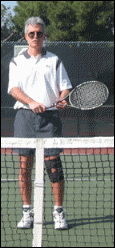
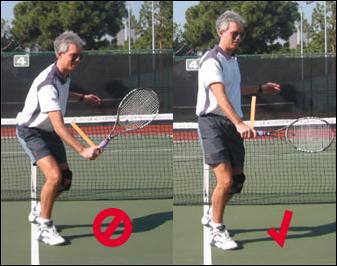
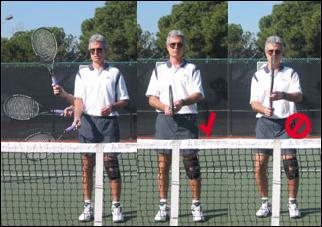 Take the ready position in this three part photo. The photo on the left shows the three options up at the net, you can hit the ball shoulder high, waist high, below waist high. It makes sense to keep your options in the middle of all three and not restrict yourself. The photo in the middle takes this common sense ready position into account. The racket face is placed waist high, and you adjust one step up (high ball) or one step down (low ball).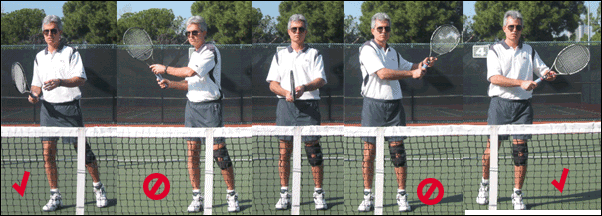
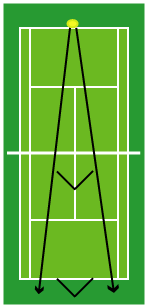 When you're up at the net the ball will never be as wide from you (left or right) as it could be when doing a groundstroke. This means you don't have to run down anything that's wide; you really have to respond to what's in front of you; you don't prepare the stroke out wide from your body at all 'cause it's not going to be like that.
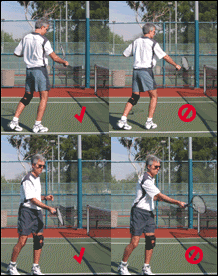 Don't turn your own head to look at the ball, just the eyes.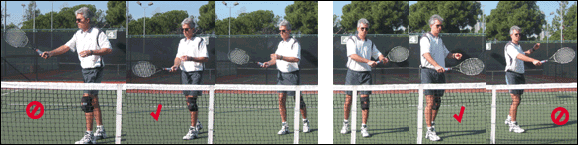
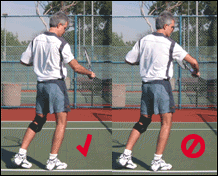
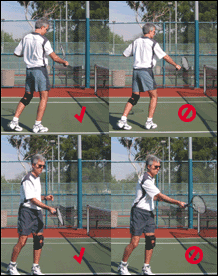
 The photo sequence on the right illustrates how this works versus the establishment's way. The forearm does not move. If the forearm moves you are calculating for a wider shot.
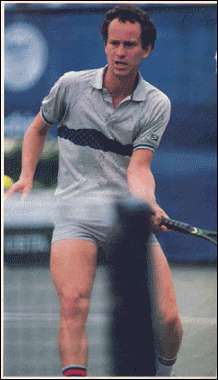 The photo of McEnroe illustrates this idea best. His elbow is close in to the body, and in front/ahead of his body (in the direction toward the net). More importantly his wrist does not form a 90 degree angle to the racket, it appears a touch droopy because the racket head is lower than the hand since the ball is struck below the waist. The idea the racket head can be lower than the hand has recently been embraced by the establishment, specifically Dr. Jack Groppel, but he, along with others, still insist on some phantom uniformity regarding a 90 degree angle between wrist and racket for high, medium, and low shots.
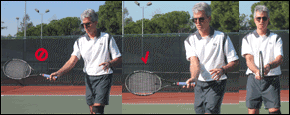 If your arm does not achieve this scrunched look, or feel that way, you not only lose leverage but strength in your hand for the contact. You've just got to play it in tighter than you think which, not ironically, is just how it is on a f/h groundstroke. Your chest needs to turn slightly to face the contact spot. As stated earlier in
  It's easier to prepare for a backhand, the forearm doesn't inhibit (moving to your side) when you prepare the racket over to your side.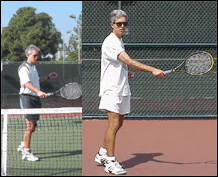
 On a backhand groundstroke the ball bounces and loses power before you hit it, you need to unfold the arm out away from you (side fence) and in front of you (the net) for max leverage to hit the ball for distance (photo far right). These parameters are not there for a volley: you hit the ball before it bounces, not for distance, and it's not as wide from you. Instead, the elbow here is held closer to the body to leverage the arm's strength in what is a smaller situation (photo left side), and for the same reasons the contact is not out in front of you as much as for a groundstroke.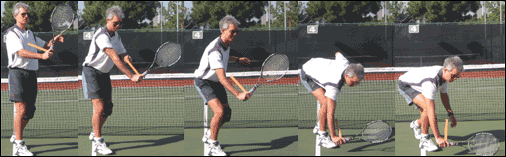
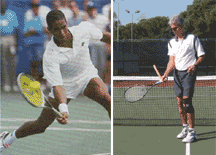 Is it any wonder players like Bryan Shelton, on the right here, have so much trouble with their game? He has no leverage on that contact spot with his hand so low, he needs to be standing up more and allowing the racket to reach down, as I show on the right, though I didn't set out to relate directly to Bryan. I should drop down farther, I'm merely standing, but the racket is working correctly. Bryan has no strength for his contact spot, a fact made obvious if I could gently push on his racket face. On the other hand, were he to stand up and lower the racket while I pushed gently on his racket face, he would feel stronger.
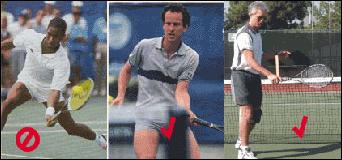 The genesis of our misunderstanding lies in the fact that on the comfortable and strong chest-high volley there is an angle of "about 90 degrees" formed between wrist and racket shaft. The problem follows when you take this observation from this one example and apply it to volleys hit lower than chest high. In so doing you are retrofitting form to satisfy an arbitrary requirement and you wind up ignoring concepts of leverage from arm to racket to contact spot.

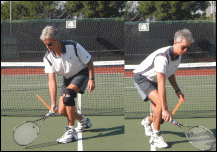
 Posture is strength. If you are too far away from the ball (ball is to your side or ahead of you), and/or bend down to the ball you're going to lose your posture and thus your strength. So get up closer to the ball and stand up to it.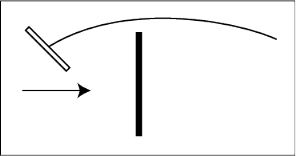
 Out in front is a teaching device for those who hit late. You're supposed to hit "out in front" so you don't let the ball get by you, but players take this meaning too literally and extend, or straighten, their arm to hit o-u-t in front. The arm is a leveraging device and needs to be bent, or flexing, during contact and not straight.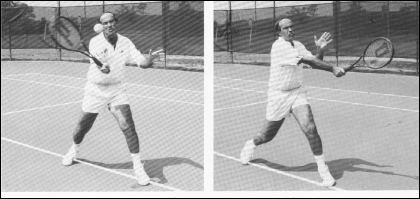
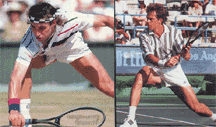 While both Pat Cash and Stefan Edberg used established technique of getting down low to the ball with the racket face cocked above the hand and volleyed well, it is clear from their styles who is the more sensitive bloke. Clearly Edberg appeared more elegant and expressive whereas Pat was more workmanlike. Edberg always maintained great posture. Compare Margaret Court with either Martina Navratilova or Steffi Graf.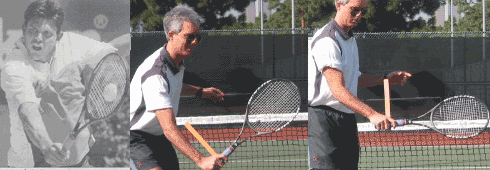



|
|
|
||||||||||||||||||||||||||||||||||||||||||||||||||||||||||||||
|
|
|
||||||||||||||||||||||||||||||||||||||||||||||||||||||||||||
























