 |
||
 |
|
|
Revolutionary Tennis |
||
|
|
|
Tennis Instruction That Makes Sense |
||
|
|
|
|
||
|
|
|
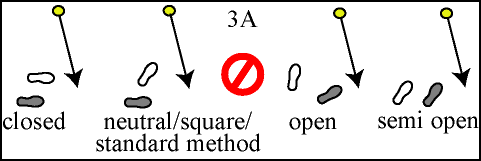
Step 3 Your Body's Power Zone Old Stances Incorrect Contact Alignment Forward Stance Out in Front Steps 1 and 2 begin to explain how to structure the foundation, your body, to empower your stroke. Move into the ball using your natural locomotion for rhythm and efficiency. Step 3 explains the relationship of your feet and body to the contact spot and the result is a new stance for tennis players: the forward stance. First, let me illustrate the popular stances known today as outlined by a self-described tennis guru. Diagram 3A shows the closed stance, open and semi open, and the neutral stance (also known as the standard method, the square stance).
The stances in 3A are all but derivations of a main theme. The main theme is based both on the body's structure and our desire to move into the ball as seen earlier. First, let me explain a simple thing about the body's structure before arriving at the main theme.
It doesn't matter whether you kick or hit a ball, tackle someone, lift a bag of groceries or a heavy box, all of these actions take place in a zone common to us all. This common zone lies between the width of the feet where the feet are for the most part parallel to each other, and you can see this zone if you look at the act from a bird's eye view and extend lines straight away from the toes. I call this common area your body's power zone. Not exactly in the middle between identical feet, simply in between them and not to the outer side of either one, and the center of your body, the groin area, faces straight ahead in the same direction as your feet. For example, a golf ball lies between the width of the golfer's feet, and the body's center faces the ball at contact. A baseball batter, standing sideways, takes one step and swivels both feet to make them identical and to place the contact between them and in front of his center. This is, initially, how your body structures itself to empower whatever it is you're doing with your arms and hands, and the height of the action is secondary to this.
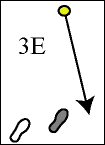
Your strokes are unsupported in 3C because the contact does not lie between the width of the feet, even though the feet are parallel or pointing in the same direction. Diagram 3C is the tennis player's equivalent of standing sideways to a box and lifting it. You may think some of the popular stances shown in diagram 3A above may meet the dual requirement of hitting the ball between the width of identical, or parallel, feet. You are half right. Either the contact spot will not lie between the width of the feet (closed stance), or the feet are dissimilar (neutral, open stance). Only the semi open stance meets the dual requirement of contact between the width of identical feet, but, as with the open stance, you're standing still on the back foot prior to swinging instead of stepping forward into the ball. Each stance in 3A requires you to compensate for the fact you've been moving off to the side instead of into the ball (1E). As a consequence you'll rotate the body to deliver momentum into the ball to support your stroke, but that's a compensatory and counter-productive technique that adversely impacts your swing, Step 4.
THE FORWARD STANCE
If you follow Steps 1 and 2 for groundstrokes and volleys, the result is the forward stance, the result is strength. With BOTH feet moving into the ball, or pointing into the ball, stepping into the ball with the front foot prior to contact finds both feet identical and the contact between their width (3D).
Diagram 3D also includes what I consider a proper open stance, which is called a semi open stance in 3A. Contact is made between identical feet, though very close to the back foot. You won't be at full strength with an open stance because it's like placing the heavy box closer to one of your feet instead of in-between them before lifting it, and you're not stepping forward into the ball.
The forward stance, for a tennis player, is the main theme. You should plan to use it more often than not. But, if you can't get to the ball in time, use the open stance. If the ball is just too close and too fast, use the open stance. If you don't want to move into the ball to begin with or step into it with the front foot before you swing, use the open stance, or the neutral stance of diagram 3A. If you need to compensate, go ahead, just don't make it the heart of your game. These stances can work, but they make you work more for your shot. And with Revolutionary Tennis, remember, less is more. THE OPEN FORWARD STANCE
The contact zone has always been described as optimally located between the hips and the shoulders, a location that suggests height is everything. I don't know about you, but the tennis ball never sits at just the right height when I hit it. Instead, the contact zone should be seen as lying between the width of the feet, allowing you to strike the ball at whatever height. After all, there is only one moment in time when the ball can be hit on time, and height is secondary to the contact's horizontal placement between the width of the feet. Contact too far ahead and you're too soon, and once past your body's center you're late, no matter the height. Step 7 elaborates more. I'm sure you've seen a photo or two of a pro's front foot almost pointing straight to the net on a backhand, looking a little awkward. Next time you do, look at the back foot's position. It will invariably be sideways, parallel to the baseline, pointing to the side fence, or even the rear fence, indicating the pro has not been moving forward into the ball. At this point the pro opens his/her front foot awkwardly to valiantly place the ball somewhere between the width of the feet. The instinct is natural to do this, but it's hard to accomplish when sideways first. Yet another difference between backhands and forehands can be seen here. There is a fudge factor regarding the contact on a forehand. The ball can be hit later, or closer to the back foot, because the racket arm is on the same side as your back foot. On the backhand there is no margin for hitting later. The racket arm is on the same side of what is now the front foot, and the contact spot lies almost even with the front foot. This is why a backhand open stance is becoming more popular, you can hit later. If you're sideways, should you then swivel one or both feet, like a baseball batter, to place the contact between them and in front of your body center? If you're in an open stance, should you rotate the body to generate momentum? You could, but you'd be adding layers of difficulty unnecessary for tennis. Step 4 explains. Turning sideways, moving parallel, taking small steps to move, dragging one foot behind you, stepping across or sideways, using an open stance, each one works against developing a strong foundation with the body. No wonder your strokes suffer. An even greater misconception is how to achieve power, Step 4.
|
||||
|
|
|
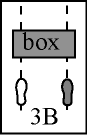
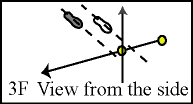
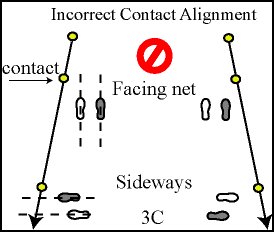 The contact spot for a tennis player is our task, and as such the contact spot must line up between the width of identical feet in front of the body's center for the body to empower your swing into the contact spot. This is the same as your body empowering your arms to lift the box. But diagram 3C shows how this fundamental alignment does not occur when the front foot steps sideways (and contact is made out in front/ahead of the front foot), or when both feet face the net, often misunderstood as the open stance.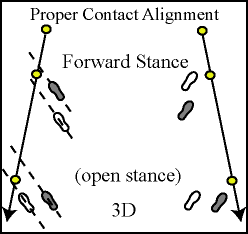



|
|
|
|
|
|
||||||||||||||||||||||||||||||||||||||||||||||||||||||||||||||
|
|
|
||||||||||||||||||||||||||||||||||||||||||||||||||||||||||||
























