 |
||
 |
|
|
Revolutionary Tennis |
||
|
|
|
Tennis Instruction That Makes Sense |
||
|
|
|
|
||
|
|
|
How To Apply Step 2
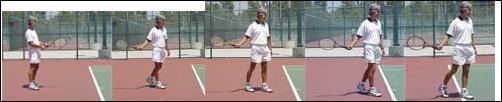
How The Feet Work You want to take four steps into the ball from your ready position. They must be complimentary and into the ball.
ready position Step 1 Step 2 Step 3 Step 4 Once you get over the initial jitters and move forward, the habits you most likely have that conflict with simple, efficient movement are:
- your first step turns out to the side, called a unit turn
- your first step is too short, or that foot doesn't get off the ground and move forward. - you take only two long steps. - you take too many steps, that is small steps, a.k.a. small adjusting steps. - you stutter step while moving (the side of your body) forward, and drag the back foot - four steps leave you way past the contact spot (steps are too long). - you get too close to the ball because you're moving over too far to the side and cause the ball to run into you. - you don't move straight to the ball, facing it. - you're too busy counting your steps and forget to swing.
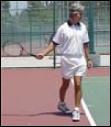
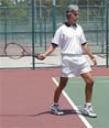
- the penultimate step with the back foot, number 3, doesn't point at the ball but to the side fence instead (photo left - Step 3 turns out to the side).
- at end the front foot, number 4, doesn't point into the ball but steps across and points to the side fence instead. - your last step, number 4, lands toes first instead of heel first (right).
- your last step isn't long enough. - you take your steps but you don't swing on time. You can make life easier for your stroke by moving smoothly, economically, and efficiently. Focusing on your movement makes for a better tennis stroke, while focusing on your tennis stroke doesn't help you move better. WALK INTO THE BALL Start by walking into the ball. Move the correct foot forward first, and take a second step. Now take two more steps between where you are and where the contact will be. You may feel you don't have enough room, but you'll have to do what I call making the feet fit. That is you have to make four steps fit between your ready position and the contact spot. Walk this out on the court. Make the four steps fit. Don't skimp on step #1 or #3. Ultimately, the last one adjusts as needed, but certainly not to make up for distance because of a previous step's shortcomings. Now walk a little faster, using four steps. You'll get a natural, instinctive feeling on when and how to shorten your stroke's overall length. The crucial deal is to keep the feet moving forward in a complimentary way with four steps. Start with "longer" steps, then smaller ones. I put "longer" steps in quotes because the first two steps never have the chance to be full steps because they're starter steps. And because of that, the first two steps need to g-e-t g-o-i-ng as much as possible, you can't take two itty bitty steps and expect the last two to make up for lost ground. You often hear you need to take tiny steps, or adjusting steps, to the ball. Tiny and/or adjusting steps don't exist all on their own, they're part of a larger picture. Forward is crucial, and complimentary is crucial. While the first two steps may move you into the ball, if the last two steps don't do the same and in a complementary manner, your direction and momentum will detour and leave you too far away from the ball. This happens often when the third step short-steps or steps to the side forcing the front foot to take a long step to make up distance. Now run into the ball, taking four steps. Simulate playing conditions. It becomes a little harder, yes, because you have to watch your balance and some of the steps are short steps. But these short steps must be complimentary. Moving forward, from Step 1, is hard to do. Picking up your feet and making four steps fit is also hard to do. You've been sideways for a long time, you've moved inefficiently, arrhythmically, for a long time. Cut yourself a little slack in the beginning because... IN A SHORT TIME YOU'LL FEEL BETTER And you'll see quick results. More power, a better feel. Your stroke still needs to reduce its length and oomph value, but that'll come. First comes the power and the feel, then the stroke adjusts. You can't get "the stroke" and then try to turn up the power or get the feel. This is the beginning of learning to move smoothly. Running uses the same locomotion pattern as in walking, only faster. Learn to do Step 2 by walking into the ball, then accelerating it bit by bit. There is no great skill needed to move normally, but you need to emphasize the body over the stroke. Get to the ball first, smoothly, and then hit it or it's putting the cart before the horse. If you focus on the stroke instead of the body, you'll calculate the minimum distance needed to move so you can r-e-a-ch with the stroke. By the same token, don't rush the ball. If you're having trouble one day, look at your footwork pattern and direction and ask: Am I actually moving forward to the ball or away? Are my steps complimentary? |
|
|
|
|
||||||||||||||||||||||||||||||||||||||||||||||||||||||||||||||
|
|
|
||||||||||||||||||||||||||||||||||||||||||||||||||||||||||||
























