 |
||
 |
|
|
Revolutionary Tennis |
||
|
|
|
Tennis Instruction That Makes Sense |
||
|
|
|
|
||
|
|
|
Step 7 Tennis Stroke Commonalities II: More Useful Stuff Vision Ball Placement Contact Leverage Concepts: Hi, Low Balls
Some concepts have been deleted from the Vision portion due to the new knowledge revealed in Federer's Vision Technique, as of this writing what has been written stands and something new may be added. Timing. How and when do you time your swing to hit the ball? Do you tell yourself to "swing" or does something inside you pull the trigger, even when you hit late? Your instincts pull the trigger, and they do so based on the information your brain gets from your eyes. How well you see determines how well you judge things. If your eyes see the ball clearly in 3 dimensions, if you reference correctly where the contact spot must lie, and if your head remains still prior to and during contact you'll hit the ball on time. This is all a very tall order. "Watch the ball" is a popular idea, and it is 100% right-on. Watching the ball well not only leads to perfect timing, it leads to enhanced mental concentration. But how do you watch the ball well, and how can you fix things when your timing - your vision - is off? SEE IN 3-D Both eyes must see the ball head-on to see it clearly in 3 dimensions. Sure, you can see the ball with your peripheral vision, but your two eyes and your nose must point straight at the ball as they're pointing now at your computer screen or the information your brain receives about the ball's flight won't be 100% accurate. With the right information your instincts cause you to swing on time, with faulty information your stroke fires at the wrong time. It's hard to catch a ball thrown at you if your head is turned sideways to it. It's harder yet to hit a moving object with your eyes sideways to it. As an example, turn your head away from the computer screen a little bit and close the eye closest to the screen. Your other eye sees the bridge of your nose, right? With both eyes open you could still read with your head turned slightly to one side, but it would get to you. Keep this in mind for the following.
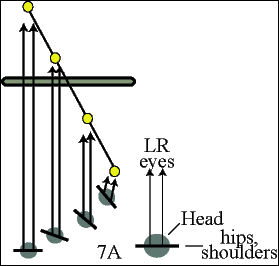
Diagram 7A shows your eyes tracking the ball during the often successful forehand. The eyes on the first image of the head see the ball head-on and clearly in 3 dimensions. The subsequent images show that as your shoulders and hips turn as a result of moving into the ball, your head counter-turns to keep both eyes directly on the ball. (For simplicity, one line represents both hips and shoulders, though, as diagram 4G shows, the shoulders can turn more.)
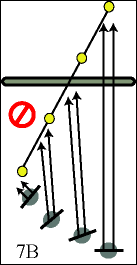
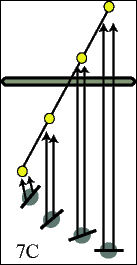
This counter-turn for vision adjustment doesn't occur as easily for backhands because the racket arm pulls across your body when taking the racket back. As a result, your head is turned too much to the side, 7B, and while you see the ball, the bridge of your nose impedes your back eye's look at the ball. You don't see clearly in 3-D without the back eye balancing the ball's image. With the front eye's image dominating, you see the ball too far out in front and will swing too soon. Bad timing. The ball goes sharply to your right. To help your backhand's timing, see the ball better by counter-turning more than what feels comfortable. You have to work at this to keep both eyes clearly on the ball at contact, 7C. Open your face toward the net to allow your back eye an unimpaired view of the ball during its flight.
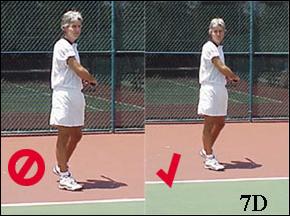
Photo 7D is taken from a crosscourt ball's point of view heading to my backhand. Both of my eyes can see the ball in the photo on the right, my face is "open" to see the ball clearly. My face is turned too much to the side away from the ball in the photo on the left, toward the net post, and my back eye can't see the ball clearly at all. The back eye is the most important of the two eyes. It balances the depth of the ball coming by you. Together with the front eye a composite picture in 3 dimensions is created. Turning sideways forces you to counter-turn your head even more to see the ball clearly. Ouch. Another situation where turning sideways is counterproductive to performance. REFERENCE THE CONTACT SPOT Your eyes don't see every moment of the ball during its flight as smoothly as a movie camera panning the horizon. Scan the wall ahead of you and notice a curious effect. Your eyes track the wall points at a time - each point is a reference point - and your brain puts them together for you. You need to reference a specific point, or moment in time, in which to hit the ball. This moment is often more out in front of you along the ball's flight line than you're aware of. Hence the term "hit out in front."
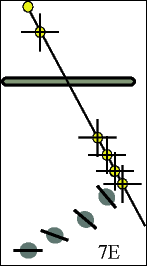
Diagram 7E shows a ball in flight and how your eyes track the ball. Each ball image is a reference point in time and space. If you reference the last ball in 7E's sequence as your contact spot you'll be late. The one ahead of the last one is the "correct" one, typically farther ahead along the ball's flight line. This applies for backhands and all other strokes. Your eyes see the ball in different points in time, like an image in a strobe light. You can't swing when the ball's at the right reference point in time because it'll take too long for your racket to get to it. You have to swing before the ball reaches that correct reference point in time. It's easy to time the ball when it's slow, but when it's faster you need a more sophisticated method. To hit on time your eyes will jump from where the ball is in flight to the correct reference point a fraction of a second before the ball actually reaches it. In that fraction of a second your stroke fires and hopefully contact is made at the right moment in time. In 7E there are four ball images on your side of the net, with number 1 being the one farthest from you and closest to the net, number 4 being the one closest to you. Your reference point for perfect timing is number 3 (matching diagram 7A). Your eyes will jump from ball image number 2 to the empty space it will soon occupy as image number 3. Your stroke fires when you're looking at reference point number 3. The racket face, and ball, and reference point, hopefully become one. Your head doesn't move when referencing the ball, only your eyes move, jumping ahead in time. This is difficult to do, to say the least, but more easily achieved on your forehand because your face is never potentially as turned to the side as on your backhand and your head seems to remain still better during the forward swing. Pros need to reference the contact spot too, it's too impossible to literally see the ball into your strings, and when the ball's too fast to mark the reference spot, muscle-memory and adjustments fill in the gaps. ADJUST YOUR TIMING Miss-hits are often caused by poor, or incorrect, vision, as well as a lack of head-on contact with the ball, Step 6. You move well, you swing well,. but there are some (or many) days when the contact isn't solid, the ball doesn't travel well. You're not seeing the ball clearly. The first solution is simply to keep your head steady during the swing. But sometimes real tweaking is necessary to resurrect your timing. Let's say you're hitting late on your forehand. This simply means you're turning your head to the side too much before stroking, you're watching the ball go by you essentially. To correct this stop the extra lateral head tracking movement and insist on a reference point farther ahead. Keep the back eye facing forward more. Some days you'll have to force yourself to swing, on others your instincts will readjust. Good forehands are hit earlier than expected. It's rare that you hit the forehand too early, but if you do, you're not tracking the ball laterally enough. Your face literally isn't moving to the side a little bit. Ironically, a backhand hit too early means your head is turned too much to the side from the very beginning. Here your vision's impaired (7B) and you'll hit too soon. You need to open up your face and reference the contact spot sooner. In the minority of cases hitting a backhand too early means you're not tracking the ball long enough into your stroke. And if you're hitting late, like on the forehand above, you're watching it go by you. BUT DO YOU REALLY HAVE TO LOOK AT THE BALL? A charismatic tennis teacher with a tennis college insists you shouldn't waste your time trying to look at the ball during contact. He states the human eye is incapable of seeing the ball strike the strings because it happens so fast, and that large numbers of photos with the pros' eyes looking not at the ball at contact but elsewhere is evidence you shouldn't bother. A common sense response is that the photos with the pros' eyes not on the ball at contact serves notice how hard it is to do. I assure you pros are trying their hardest to look at the ball while hitting it. And aren't photos with the pros' eyes on the ball at contact evidence you should? Of course you watch the ball until your racket strikes it. You don't see the ball on the strings as clearly as a high speed photograph captures the image, that's for sure, but you see a blur, an event, if you've referenced the contact spot accurately. It's not easy to line it all up, but it helps to look at the ball.
BALL PLACEMENT The popular tennis ideas of hitting crosscourt or down-the-line depend on which side of the court you're on, as opposed to the direction of the strength of the stroke and whether or not you get to the ball on time. These popular ideas fracture your concentration and promote selecting what often is the stroke's weakest shot.
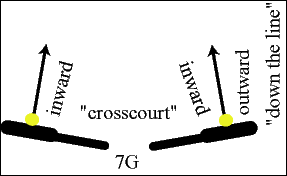
Revolutionary Tennis proposes there are two directions the ball can go when it leaves your racket face, either to the left of the contact spot or to the right, 7G. Step 6 shows how the strokes' strength lies inward from the contact spot, as an arc to a (the ball's) tangent, and that head-on contact creates a right angle against the ball's flight line, 6B. For want of a better term, this direction inward from the contact spot I'll call crosscourt. If you hit late, or if the racket face is parallel to the net at contact, the ball heads outward from the contact spot. The contact here is weaker, and for want of a better term, I'll call it down-the-line. If you're right handed in the middle of the court, your forehand goes crosscourt to your left, to the left of the contact spot. A down-the-line goes to your right, to the right of your contact spot. The opposite works for the backhand: crosscourt to the right, down-the-line to the left. In other words, ball placement direction is stated simply as: THE STROKE ON YOUR RIGHT SIDE the ball goes to the LEFT of the contact spot = Crosscourt THE STROKE ON YOUR LEFT SIDE the ball goes to the RIGHT of the contact spot = Crosscourt I know you're saying, "Wait a minute, that's not what I hear on t.v. or read in magazines." Hold on, I'll explain. A common theme in Revolutionary Tennis is to look at the game from the ball's point of view, the racket's point of view, and the body's point of view. It's no different here but the popular idea is that crosscourt means the open court and down-the-line means the nearest sideline. This creates a contradiction. POPULAR PLACEMENT IDEAS THE STROKE ON YOUR RIGHT SIDE the ball goes from DEUCE COURT from AD COURT to the LEFT of the contact spot = Crosscourt = to the RIGHT of the contact spot
THE STROKE ON YOUR LEFT SIDE the ball goes from DEUCE COURT from AD COURT to the LEFT of the contact spot = Crosscourt = to the RIGHT of the contact spot If you notice, one direction is called crosscourt on one side of the court but it's called down-the-line on the other side of the court. On the deuce side the ball leaves the racket face going to the left of the contact spot and it's called crosscourt, but on the ad side it's considered the same "direction" when it goes to the right of the contact spot. Contradictory and confusing. Something more to think about has been added to your game. TAKE YOUR BEST SHOT Go with your stroke's strength per your timing with the ball. Go with your best shot or you're compromising the hit. You need to concentrate on the hitting, not on variables that will detract from that focus. Don't evaluate which side of the court you're on before deciding on crosscourt or down-the-line; don't take the time to figure out where the open court lies, or in which direction your opponent's backhand lies; don't worry about hitting behind the opponent or into the open court. Keep it simple. Elegant. Basically speaking, when you get to the ball on time you hit crosscourt, when late you hit down-the-line. This generally translates into hitting crosscourt when you're closer to the middle of the court than the sideline, and down-the-line when you're closer to the sideline than the middle. These directions are per the ball's and racket's point of view. Take your best shot, always, even if your opponent stays right where you want to hit it. Your shot is compromised when you try to hit against the stroke's strength, your shot is weaker when you try to hit down-the-line when it should have gone crosscourt or when you insist on NOT changing the ball's direction. Yet this happens all the time. I used to serve and volley. I'd rush the net, and while preparing for my volley I'd evaluate should I hit it to, A) his weak side, B) to the open court, or C) behind him. Too much to think about. All I needed to do was evaluate whether or not I was on time with the ball. If I was, bang, crosscourt. If late, bip, down-the-line. These directions were connected with my stroke and the ball, not with the court itself, and with less to evaluate my mind was freer to focus on the ball. REAL-TIME SITUATIONS Serve And Volley Serve into the forehand or backhand corner, Deuce or Ad court. Return goes to your right. You're close to the center, you're not stretched out. This means you're getting to the ball on time. Hit crosscourt. Or you're stretched out, late, and now closer to your sideline than the center line. Bip, down-the-line. Return goes to your left. You're on time, closer to your center line. Crosscourt. Or you're late, stretched out, reaching. Down-the-line. Before I go on, I advocate taking your best shot. This might result in hitting right back at your opponent, but s/he'll won't handle your best return well enough to hurt you. If they get it back, you win with the second volley. Volleying down-the-line will keep you in the point for a second shot, whereas if you tried pulling this shot crosscourt your volley won't be effective enough and it's harder to get ready for the next volley. Mistakes are made in hitting crosscourt when you should have hit down-the-line, or vice versa. Don't try to pull the ball crosscourt when it doesn't go to your stroke's strength, don't invert the ball down-the-line when the strength lies crosscourt. Returns (righties only) Ball goes into your FOREHAND corner. You're on time, go crosscourt. In the deuce court the ball goes to your left, across the court. In the Ad court it also goes to your left, it stays on the same side you're on. When late hit down-the-line. In the Deuce court it's down the sideline, often a winner or to elicit a weak return. In the Ad court this shot goes "inside out." Ball goes into your BACKHAND corner. You're on time, crosscourt, to the right of the contact spot. In the Deuce court it's down the nearest sideline, often to an opponent's backhand. In the Ad court, it's across the court. When late, down-the-line. In the Deuce court, it's "inside out." In the AD court, it's down the nearest sideline. When you're late getting to the ball served down the middle of the court you're sending the ball down-the-line, "inside out," which in this case happens to be the stroke's strongest choice. I think you get the picture by now. When you're trading crosscourt shots and you choose to hit down-the-line, unless it's good enough (less than one racket length from the sideline) your opponent will be on it before you've repositioned to the other side of the center mark. It's risky. TO CHANGE OR NOT TO CHANGE THE BALL'S DIRECTION Ball placement isn't about not changing the ball's direction. "Don't change the ball's direction" is an apparent axiom in tennis, it means hit the ball back where it came from. Yet this popular idea also asks you to evaluate a variable that has nothing to do with your stroke's strength and makes it harder to concentrate. If your stroke's strength means you need to change the ball's direction, do so. This happens in only a couple of scenarios, and in reality you're hitting the ball more (naturally) crosscourt instead of literally right back where it came from (by restricting the stroke). EXAMPLE Your opponent hits a ball to your backhand corner. You run around your backhand to hit an inside out forehand back to his/her backhand, thus not changing the ball's direction, hitting it back where it came from. If you're on time here and go with your stroke's strength, the ball goes to the inside of the contact spot, crosscourt. This sends the ball down your backhand sideline, but the distance in this direction is less than down-the-line (inside out), the net higher, the repositioning requirement more demanding, and if the shot isn't within one racket length of the sideline you're in trouble. Players hit "inside out" because there's too small a window to go crosscourt, and they want to avoid their backhand. But if you're standing not so far over in your own backhand corner, if you're halfway between your corner and the middle hashmark, there's enough room to go crosscourt. Let's say you rush the Ad court and hit a forehand volley crosscourt when you're on time and closer to the center line than the sideline. This "changes" the ball's direction, you're not volleying back where the ball came from, but it goes with the stroke's strength. Same when rushing the deuce court and hitting a backhand volley when you're on time. What "don't change the ball's direction" really means is don't pull the ball crosscourt when you should have gone down-the-line, don't pause to go down-the-line when you should have gone crosscourt. This sounds familiar. Go with the stroke's strength and improve your concentration by not cluttering your mind. BREAK THE RULES..? When you know the rules and work with them comfortably, you can break them because you'll prepare to compensate for the stroke's added instability in doing so. You won't try to hit it too hard or go for too much, you'll place the ball because the shot's weaker by definition and you'll get ready for a return.
THE CONTACT ZONE
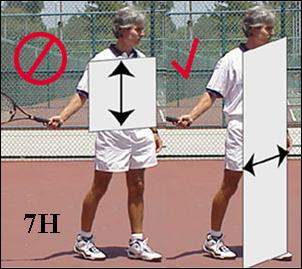
The contact zone has always been described as located between the hips and the shoulders, 7H, left, which is similar in concept to baseball's strike zone for a batter. But in tennis you can hit the ball well when it's lower than your hips or higher than your shoulders, and you can't let one go by because it's out of your strike zone. Step 3 illustrated your body's power zone, that is contact takes place between the width of identically placed feet. Instead of looking at the contact zone for tennis as an area that has just a certain height to it (between hips and shoulders), you should look at the contact zone as an area with a certain width to it (between the width of your feet). This creates a vertical plane, and takes into account striking the ball at whatever height, 7H, right. Height is secondary the contact's placement between the width of the feet, and it's the same for baseball. It's not the height that counts, it's where the contact lies between the width of the feet. Contact too far ahead in this zone and you're too soon, too deep in the zone and you're late, no matter the height. Contact is often stated as hitting out in front. Step 3 illustrates this does not mean in front of your foot, or ahead of you. It simply means out in front along the ball's flight line, hitting sooner rather than later.
The arm almost throws the racket at the ball. As such, it flexes, it is never rigid. You'd never throw a ball with your entire arm locked in one place. As seen in Racket Acceleration, the wrist flexes forward to deliver the racket into the ball on your forehand groundstroke, but not on your backhand. The wrist needs to be locked on the backhand (and volleys), though it easily breaks backwards before or during the hit because it's the point of least resistance.
HIGH BALL = LOW BALL LEVERAGE DYNAMICS The popular idea on high balls is to extend and straighten the arm farther away from the body for contact. A popular southern tennis teacher says you'll have more strength this way and not when you're closer to the ball. Fuzzballs.
You're familiar with hitting the low ball easily, but not the high one. Their realities are one and the same. Let's look at what you're doing correctly on the low ball. It feels good when you hit a low ball because the arm works properly as a leveraging device. Photo 7I, top row, middle, and right, shows low-ball contact and high-ball contact respectively. My racket face doesn't reach the fence post in either scenario, which means the contact is closer to my body horizontally than it was when the ball was comfortably waist-high. Contact for the low-ball is NOT the same distance horizontally from my navel as with the waist-high ball, it's CLOSER in order to maintain leverage with the arm. The same for a high ball. 7I, bottom row, shows the curious effect of extending out to the ball. 7I, bottom left, shows my arm extended out past the post for a waist high ball, a popular idea. Here leverage is lost. 7I, bottom middle, and right, shows me reaching out to the pole itself for either low or high ball, maintaining the same horizontal relationship to my body as when the ball was comfortably waist high in 7I top left. Here my posture is compromised and my leverage/strength suffers.
Beats me. Maybe you'll be too strong and won't be able to control it. But I know one answer is that by straightening the arm on the backhand you get to "swing" more and feel like you're getting more, though the lack of leverage here means you're a stroke guzzler. These leverage dynamics for groundstrokes also apply to low and high volleys. Getting down to the low volley in traditional form leaves your arm in a weakened position. A later Step about the volley will explain further.
THAT'S IT All right. So you're moving into the ball well, compressing the arm for the forward swing, hitting the ball head-on, referencing the ball on time, and holding yourself during the hit to prevent rotation from adversely impacting the quality of your stroke, and you're not getting a solid hit? Possible, but doubtful. But still possible. You need help with the stroke itself, then, that is with the way your arm works. You're not using it right, it's missing something. There's a lot that's missing if you follow the tennis establishment's advice. There are many stroke styles, as there are house designs, but they all adhere to the structural concepts of the arm and shoulder for leverage and strength much like a round or square room adheres to structural concepts for load bearing and support. In the pros some strokes are more solid than others and produce results with less effort and work, while others lead to inconsistencies and injuries. I will describe strokes that are efficient, that require the least amount of effort. These strokes are also known as compact strokes. You'll be able to achieve this coveted stroking style because your body will be supporting you 100% due to the ideas proposed here in Revolutionary Tennis. Let's move forward to Step 8, The Forehand. Yeah.
|
|||||||||||
|
|
|
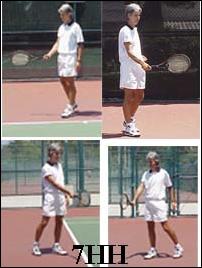 Contact is often stated as extending your arm away from your body laterally, or extending it toward the net, during the contact. Your arm leverages your body's power into the ball, and adheres to leverage mechanics. As such your arm is always bent, and closer to your body in every direction rather than extended during contact, 7HH. If you reach out to the side, or reach out in front of you, the arm straightens and loses leverage. Ouch.
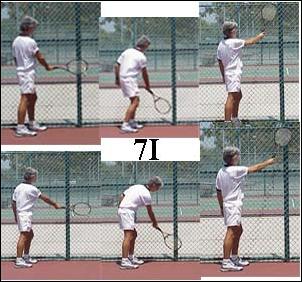 I'm using the fence pole in photo 7I, top left, to show how far away the ball is from my navel when the ball's waist-high. The pole represents X distance horizontally from my navel, the fence itself is "out in front," and the ball's waist high. I urge you to try these examples and show yourself which position provides greater strength.
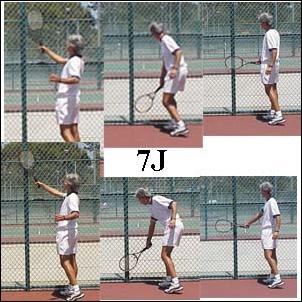 7J offers the high backhand that bothers us all. The top row shows the same leverage relationship with the body and contact as in 7I above, and the bottom row shows the configuration for leverage loss, extending the arm away from the body. Compare these positions for yourself to see where and how your arm feels stronger. I bet you'll find it's stronger when it's closer to you rather than extended away from you. The high ball's contact is exactly the same as for the low ball, the arm comes in closer to the body for greater arm strength, it is not the same distance horizontally from your navel as when it's comfortably waist high. Now why don't we do this?


|
|
|
|
||||||||||||||||||||||||||||||||||||||||||||||||||||||||||||||
|
|
|
||||||||||||||||||||||||||||||||||||||||||||||||||||||||||||
























