Tennis demands movement into a ball and stroke repetition, all within a small playing field. Except for the hand-eye coordination, a golfer or baseball batter's body technique during the swing is of no use for a tennis player because their realities are much different. Body rotation for power is required when the player does not or can not move, moves very little, or the field is large. It's clearly apples and oranges when comparing tennis with golf and baseball.

Steps 1 and 2 describe moving INTO the ball with 4 steps on groundstrokes. When you move INTO the ball your linear momentum is also directed INTO the ball, they go hand in hand. Movement equals power. Movement into the ball automatically places the contact between identical feet, Step 3, and delivers power into the ball (4A, 4B) without the need for compensatory technique.
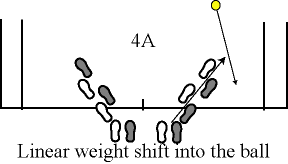
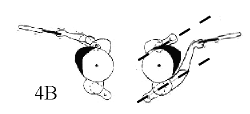
Roll the mouse over 4B to see the direction of the weight shift.
LINEAR MOMENTUM "INJECTS" POWER ON A STRAIGHT LINE
The back foot doesn't stay flat on the ground, it goes up on its toe when you shift into the ball. You already know how to do this. Get up and walk s-l-o-w-l-y. Notice how your weight goes from one foot to the next, and how each foot moves heel to toe. The back heel lifts, leaving only the toes touching the floor when shifting onto the front foot.
On the tennis court keep moving into the ball to shift the weight into the ball. Don't hesitate, pause, or pull back. I know that sounds obvious, but imagine you want to kick a soccer ball back down field and you're told to run toward the sidelines, get "in position," and then kick it. Or you're told to run up to it, turn, shift your weight back away from the ball, then into it and kick. These two examples represent the standard advice on weight shifting for tennis players. Less is more.
WHY NOT BODY ROTATION?
Body rotation is designed to shift weight if you're not moving into the object to begin with, or if you're standing still prior to contact. But a tennis player gets to move, and should take advantage of this huge benefit by moving into the ball instead of to the side fence.
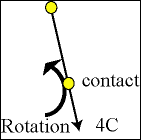 Body rotation by definition means the body rotates inward from the contact spot, no matter the sport. From overhead, the trajectory of a tennis ball is a tangent line, angling away from the player, and it continues to angle away at contact. The direction of the body's rotation here is inward from the tangent line, inward from the contact spot (4C). Body rotation by definition means the body rotates inward from the contact spot, no matter the sport. From overhead, the trajectory of a tennis ball is a tangent line, angling away from the player, and it continues to angle away at contact. The direction of the body's rotation here is inward from the tangent line, inward from the contact spot (4C).
Or look at it this way. Stand and face your computer monitor. Draw an imaginary line perpendicular to it from your body center. This line has a fixed length to it. Rotate your body to one side and notice how your imaginary line arcs inward from the monitor.
As a tennis player you face the reality of a ball angling away from you. If you rotate your body during the swing, this means both your racket and your body are moving away from the ball at the same time the ball is moving away from you. ¡Ay caramba!
Linear momentum is an easier and more reliable source of power than angular momentum. Its mathematical equation is simpler as well. When a tennis player rotates, it's overkill, counterproductive, and everything gets more complicated. What happens when a golfer or batter tries to hit the ball harder? They rotate more, and their accuracy suffers.
LINEAR BODY WEIGHT SHIFT
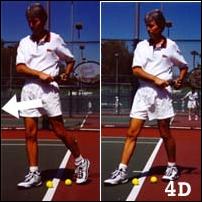 The length to the linear shifting of your body weight is small. This is the main advantage, there is very little "shifting" to do since you've been moving into the ball. The tennis balls placed below the center of my body in photo 4D represent this length, and the arrow shows the direction of the shift. Aggressive players will add more length to this shift by taking a longer stride. The length to the linear shifting of your body weight is small. This is the main advantage, there is very little "shifting" to do since you've been moving into the ball. The tennis balls placed below the center of my body in photo 4D represent this length, and the arrow shows the direction of the shift. Aggressive players will add more length to this shift by taking a longer stride.
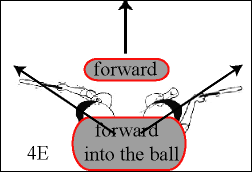 Let me show the direction in which your weight shift should proceed. 4E shows the difference between shifting your weight forward into the ball, or shifting it "forward" toward the opponent in the direction of your stroke, which isn't forward into the ball. You shift into the ball, and there is only one direction for that. Let me show the direction in which your weight shift should proceed. 4E shows the difference between shifting your weight forward into the ball, or shifting it "forward" toward the opponent in the direction of your stroke, which isn't forward into the ball. You shift into the ball, and there is only one direction for that.
If you're like most players, often your momentum has been going to the side fence. You're sideways, and to compensate you'll rotate your body to redirect your momentum more into the ball. Unavoidably, this rotation adversely impacts your stroke.
Or, you'll rotate your body to generate momentum from an open stance because you've stopped moving, you won't step into the ball. Ironically, this momentum from rotation will not go into the ball but away from it, the largest single source of unforced forehand errors in the pros. On a replay after the pro has netted an easy forehand, notice how severely he or she rotated the body inward from the contact spot toward the opponent's side of the court, that is away from the ball.
I know the idea of no body rotation is different. It runs counter to the established method. Well, if you move into the ball correctly with both feet, step into it with the front foot, shift your weight linearly into the ball, and don't rotate the body during the swing, you'll be amazed at how strong your contact is with linear momentum as a power source. Large muscle groups are still responsible for transferring weight, only now their contribution is linear, not rotational. This is a new idea. Revolutionary.
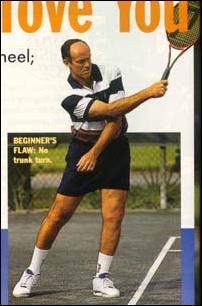 The establishment always points out that upper body rotation is an integral part of a forehand's stroke production, and they try to prove their point by illustrating what they think is the opposing viewpoint in the photo on the right. That is, they literally hold their torso sideways, swing, and look terribly awkward. The establishment always points out that upper body rotation is an integral part of a forehand's stroke production, and they try to prove their point by illustrating what they think is the opposing viewpoint in the photo on the right. That is, they literally hold their torso sideways, swing, and look terribly awkward.
The article says, " Beginners and intermediate players often use insufficient trunk rotation to take the racket back, so as they swing forward, trunk rotation into the ball is non existent and the swing is made with the arm alone." [This corresponds to the picture, but it seems the me the trunk has rotated out of the ready position, it is not facing the net.] Continuing, " More advanced players tend to do just the opposite. They rotate the trunk so quickly into impact, and so out of sync with the arm, that they look as though they are pulling out of the shot. When the trunk is in position for ball contact - basically facing the net - the arm lags way behind, again causing the arm to largely work alone." [Noteworthy here is how the trunk is considered to be in good position for ball contact when it basically faces the net, itself a definition of overrotation prior to contact, and how advanced players rotate so quickly it's wrong. Hmm. I don't get it. I can't swing with only the arm, my torso needs to rotate to face the net at ball contact for correct form, and I can't rotate so quickly I'm out of sync with the arm.] The author's solution is to hit "with shoulder rotation...to drive the ball with the shoulders." (tennis magazine, 02/95, photo by Caryn Levy.)
Revolutionary Tennis argues that the body directs its weight shift into the contact zone, no matter the endeavor, and for tennis we shift our weight into the ball contact and not towards the opponent. The slight rotary movement that can be present on the forehand's forward swing is present for, and directed into, only the contact. The torso thus is not facing the net. After contact the body can and will rotate, due to the swing, not the other way around. It's a radical idea you shouldn't rotate while swinging the racket into the ball. There will be a slight amount up until the contact, but that amount is a non-teach thing, it's normal, and it's very hard to teach someone to do it. The problem lies when rotating consciously as part of the stroking dynamic. That is counter productive, as seen so clearly in the article quoted above.
LESS IS MORE SIMPLE IS BEST
Let's talk about turning the body, because I know the popular idea is to "turn" the body when you take the racket back. First, when you move you automatically turn the hips and shoulders, it doesn't work the other way around, shown in diagram 4F. Movement = turning, as illustrated when hitting on-the-run forward into the court. Very few students move across the court with their shoulders parallel to the net.
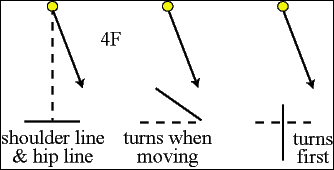 Second, if you turn first, you've turned the body and its momentum away from the ball. With this over-turn, you'll have to re-turn the body into the ball to support the stroke at contact. All of that adjustment, especially in such a short amount of time, adversely impacts any swing. Compensatory technique should not be offered as a model. Second, if you turn first, you've turned the body and its momentum away from the ball. With this over-turn, you'll have to re-turn the body into the ball to support the stroke at contact. All of that adjustment, especially in such a short amount of time, adversely impacts any swing. Compensatory technique should not be offered as a model.
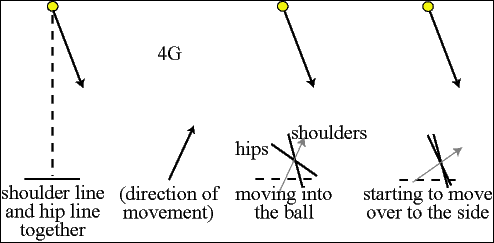
Third, and last, what about the popular idea of turning the upper body a lot first, winding it up, to accelerate the stroke more via rotation? Step 6 elaborates on why this doesn't work, but for here let me refer you to diagram 4G. As long as your feet and hips (your body center) lead you into the ball there will be a limit on upper body rotation, or wind up. If, however, you allow your hips (body center) to turn more because the upper body winds up, you'll find yourself and your momentum no longer moving into the ball but away from it. Your stroke then needs more time to curve its way around to line up into the ball, and, more importantly, hitting on time becomes more difficult to achieve (more on this in Step 7).
FOR ADVANCED PLAYERS...and those who aspire to be
I have received a lot of feedback regarding upper body rotation on a forehand. For advanced players the answer is yes, there is some, if you want to call it rotation. But when I asked a student of mine who's an attorney whether or not she considered what follows to be rotation, she answered, "Not really, because I'm trying to lock my torso after a point." Let me explain. What follows also applies to two handed backhands.
Diagram 4H begins, like 4G before, showing the limit to the upper body's coiling, or turning, while moving forward into the ball. Next, during the forward swing, the torso re-turns to match the angle of the hips beneath it, something it wants to do quite naturally. And if the torso stops when it matches that angle it acts as a boost to get the racket going. By stopping its limited rotary movement, the torso helps accelerate the racket ON ITS OWN. This is similar to cracking a whip, where the handle stops and the rest of the whip accelerates and continues beyond it, or similar to a hammer throw, where the body prior to release stops its rotary movement to help the arms accelerate the throw.
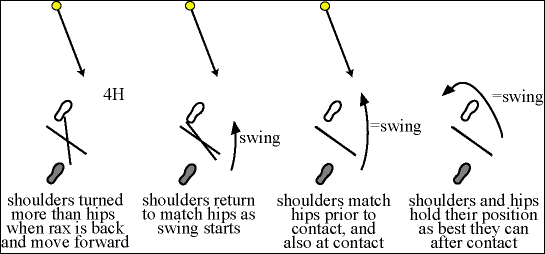
The stroke does not accelerate as much as explained above if the shoulders continue to rotate (and the hips) in the direction of the swing and wind up facing the net. There is a point in tennis where rotary movement becomes counterproductive to stroke speed and contact control, a point easily breached when either hips or shoulders rotate to face the net in an effort to accelerate the swing. Tennis is not golf or baseball. We need to move, adjust our stride and closeness to the ball, adjust the stroke, exercise more control over the hit, keep it in a small playing area, and get ready to do it again a few more times for one point.
 return below to juniors return below to juniors
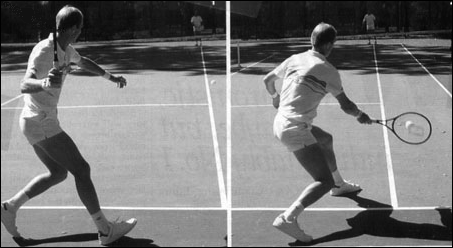
I'm including a photo here of the great Stan Smith to illustrate the movement in 4H. Stan's explaining something about hitting down the line with these two photos, but a few things prominent to Revolutionary Tennis stand out even though these aren't mentioned in the article. It's clear that 2 steps are taken prior to contact and that both feet are identical, or pointing into the ball (Step 2 ). Stan's shoulders are turned more than his lower body (photo left), and then his shoulders re-turn to match the hipline (right) per diagram 4H. His contact spot lies between the width of his feet (Step 3), and his overall posture is good (Step 5). This photo by Fred Mullane appeared in Tennis magazine.
How can you learn the movement described in 4H? In a word...
FLEXIBILITY
Flexibility in one's body as a whole is a key ingredient to athletic performance. It's not just about being able to bend over at the waist and touch your toes with your hands, it's about increasing your body's range of motion so you can perform more easily. Increasing your range of motion allows you to swing faster, to swing on a moment's notice, and to avoid injuries. Think of the service motion of any top tennis pro, think of Tiger Woods or Kobe Bryant.
We're talking upper body flexibility. The torso, back, and shoulders need to be flexible, or supple, to increase their range of motion. On a forehand groundstroke, the torso needs to swivel, or rotate, to some small degree left to right and right to left above the hips and around the spinal column. This kind of flexibility is normal because your lower body and upper body are not fused together, they move independently of each other.
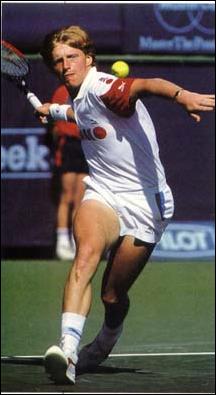 Becker's forehand illustrates how the upper body turns more than the lower body while at the same time the lower body's moving forward to the ball. His range of flexibility marks him as a professional, borne from years of practice and of starting at a young age. Younger players can aim to have his flexibility by young adulthood, but adults need only to avoid fusing both halves of their body. [Becker photo by Stephen Szurlej, Tennis Magazine, 03/88.] Becker's forehand illustrates how the upper body turns more than the lower body while at the same time the lower body's moving forward to the ball. His range of flexibility marks him as a professional, borne from years of practice and of starting at a young age. Younger players can aim to have his flexibility by young adulthood, but adults need only to avoid fusing both halves of their body. [Becker photo by Stephen Szurlej, Tennis Magazine, 03/88.]
We can all imitate Becker's motion to some small degree without prompting because no one throws a ball or swings a bat without flexing the torso, but we all can't control it, that's for sure.
But this flexibility is denied if you follow the establishment's advice that you take the racket back and either pivot the back foot in place, do a unit turn, or just plain turn to the side with your front hand holding the throat of the racket to take the racket back. Why is flexibility lost here? Because now both your upper and lower body turn to the side and you're more likely to move as if both upper and lower body were fused together. This is not being flexible.
Flexibility allows you to keep the lower body moving forward while the upper body turns in what is an opposite direction during the two-beat process of taking the racket back. Not much turn is required here, but if you don't differentiate the upper body's movement from the lower body's you either won't move forward into the ball at all or your swing will be anemic.
I remember my tennis teacher, the late Mr. François Savy, turning his upper body while moving his hips forward. He gave me upper body flexibility by teaching me how to do it. I would stand at the baseline, facing the net, and I'd take the racket back on my forehand. I would turn my torso away from the net as much as I could while at the same time I walked straight perpendicularly to the net, all the way up to the net. Merci, monsieur. I urge you to do this as well, time and time again. And for backhands, too.
As a teacher I find students naturally turn the torso slightly on the forehand (good) when taking the racket back, but they naturally overrotate the shoulders forward (bad) with the swing. I guess you can't have everything. So my job is to get them to stop that forward overrotation to improve their stroke.
Some players hit successfully after both moving parallel to the baseline and rotating the body. This is good enough, from time to time, but it's harder to make this style consistent because rotation compensates for not lining up properly INTO the ball to begin with. When faced with a harder or wider ball, the weakness in this style is exposed. Furthermore, this kind of player would like to have more power yet keep the ball in. How to? Cut down on the rotation, and try moving into the ball to begin with.
Contact, for any sport, is preceded by shifting body weight into the contact area, you shift and hit. For tennis players it has been said that the timing of the rotation of the body (body weight shift) with the swinging of a racket onto the ball is crucial for success. Wrong sport. Tennis players need not rotate like golfers or baseball batters. Nor should they. And if your power isn't what you want even though you're moving into the ball and using linear momentum for your weight transfer, Step 5 will assist you.
Using a metaphor, the perfect swing works as smoothly as a child's swing swinging back and forth between the legs of a swing set. But if Mr. Bully picked up the legs of the swing set and twisted them, the swing would no longer move smoothly, it would fly off to the side. This is what happens when you rotate the body while swinging the racket, the racket can't line up into the ball smoothly.
CHILDREN AND JUNIORS
Promising young tennis players jump and rotate their bodies dramatically because they want to hit the ball hard. Force is a product of mass times acceleration. Young kids don't weigh very much and aren't very strong, so they throw every bit of mass they've got at the ball to get more zip. As they get older they will naturally hit harder due to weight gain and increased physical strength but their jumping and twisting motions will prove counterproductive in adulthood.
Power and strength develop naturally as children grow older. Since rotation is counterproductive to success for an adult tennis player, children shouldn't nourish a set of skills that will hurt them in later years. It doesn't make sense, but it happens all to frequently.
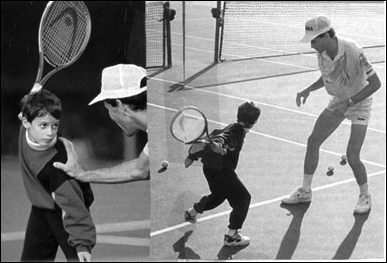 This photo, by Red Morgan, from I believe Tennis Week, is worth more than a thousand words, but I'll try to be brief. The well intentioned teacher has the boy standing still and sideways, and will drop the ball for the boy to hit. The boy learns to wind up a lot to hit with power precisely because he is standing still, in effect becoming a baseball batter. But tennis isn't baseball where you get to stand still waiting for the ball, the boy needs to learn (how) to move into the ball and balance, or reconcile, that action with his stroke and not the other way around. You can say the teacher is trying to work solely on the boy's swing and that I'm being too critical, but this teaching method is very common: both feet are sideways, the wind up is large, the ball is dropped by the boy's side, and the front foot will step toward the net instead of into the ball. Extremely unrealistic. This photo, by Red Morgan, from I believe Tennis Week, is worth more than a thousand words, but I'll try to be brief. The well intentioned teacher has the boy standing still and sideways, and will drop the ball for the boy to hit. The boy learns to wind up a lot to hit with power precisely because he is standing still, in effect becoming a baseball batter. But tennis isn't baseball where you get to stand still waiting for the ball, the boy needs to learn (how) to move into the ball and balance, or reconcile, that action with his stroke and not the other way around. You can say the teacher is trying to work solely on the boy's swing and that I'm being too critical, but this teaching method is very common: both feet are sideways, the wind up is large, the ball is dropped by the boy's side, and the front foot will step toward the net instead of into the ball. Extremely unrealistic.
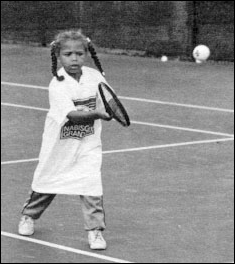
What would I do here instead? Let me refer you to the Stan Smith photo above, where he's taking 2 steps forward into the ball and both feet point identically into the ball. Or look at the young girl in the black and white photo on the left by Russ Adams. Her feet are pointing correctly, she's not standing sideways. Children do so many things naturally, don't they?
I would ask the young boy to start taking his racket back as a loop (explained more fully in Step 8 part II, How To Help Your Forehand). I would drop the ball ahead and in front of him (in the direction of the net post to the boy's right), and I would ask him to take 2 steps forward into the ball before striking it. In this way the young boy would absorb all the elements to improve his game: stroke preparation, 2 step minimum forward movement, stroking with the body's momentum behind it.
Juniors wonder why their mechanics fail them, and adults tell them inaccuracy can be overcome by quality practice. That is practicing how to turn sideways, rotate, shuffle step... The standard technique lets us all down.
It's very easy to get kids to move into the ball and hit well without rotation. But it's hard for them to see they're establishing a foundation, like roots on a tree, that will allow their game to grow unencumbered by compensatory technique. Therein lies the challenge to us teachers.
You can do Steps 1, 2, 3, and 4 correctly and still not maximize your power. That's where Step 5 comes into the picture.
ADDENDUM
Please go to On Linear and Angular Momentum to see how "loading" and "unloading" are considered linear momentum by the scientific community.

- angular momentum
- rotate hips/shoulders during contact
- shift weight straight to where you're hitting it
|
- linear momentum
- shift weight straight into the ball, into the contact
|
 
|

























