 |
||
 |
|
|
Revolutionary Tennis |
||
|
|
|
Tennis Instruction That Makes Sense |
||
|
|
|
|
||
|
|
|
Step 9 The Backhand Groundstroke Part I of II The Arm Flexes Fold And Unfold Use The Wrist...? Trust Your Instincts "Oh sweet mystery of life at last I've found you..." I doubt lyricist Rida Johnson Young was writing about finding her backhand when she penned her insightful song. But the sweet mystery in everyone's tennis life is the backhand, and yet you hear it's more natural than a forehand, or that its motion is simply like throwing a Frisbee. Hmm. To solve this mystery you're told to turn (more, more) the shoulders and hips, to lean into the ball, lift up with the legs, step to the net post, rotate the back hip, straighten the arm or extend it to hit, hit out in front, and lift and extend. You're also told to "slide your racket hand down toward your thigh" and maintain "a rigid hitting arm" when you swing. Or to stroke like "a pendulum" as if you were "bowling with the back side of the hand." You try what you're told but it doesn't help your backhand. The mystery remains. Something's missing, something's not there. You know it, but you can't put your finger on it. Everyone tells you to do the same thing, but why doesn't it work? That's because it's a case of the Emperor's New Clothes. Time for a revolution. STARTING TO UNRAVEL THE MYSTERIES... There are two mysteries on the backhand. 1. How the arm works on the stroke. 2. How the body works for efficiency and stroke support. Let's start this time with the stroke, even though it's the body's attitude that makes the stroke hum.
THE ARM FLEXES... IT FOLDS AND UNFOLDS Straightening the arm to swing, or swinging with a straight arm, dooms the backhand. The arm is working in a reverse direction than on the forehand, yes, but it still needs to be flexible to retain leverage. On your backhand the forearm "flexes" laterally around the biceps and elbow, a reverse direction from the forehand. After all, this is how your throw a Frisbee, isn't it? [The word "flexes" is in quotations because this image helps your stroke, and the terms folding and unfolding of the arm help as well. In reality I'm told when the arm is bent and "flexes," it's really external rotation of the shoulder, but then if you were to simply straighten the arm and swing away from you it's horizontal abduction of the shoulder. A proper backhand stroke combines both movements, that of the bent arm (external rotation), and of the arm swinging away from your body (horizontal abduction).]
Photo 4 exaggerates to show how the forearm "flexes" laterally around the elbow/biceps, the issue that is the mystery to the stroke itself. The forearm acts independent of the biceps and elbow and does not work in lock step with them during the forward swing. Practice this motion yourself right now. Tuck your elbow against your side, bend the arm at the elbow, hold your forearm away from your body at waist level - a typing position -and turn your hand straight up and down. Your forearm is at a right angle to the biceps, the hand is aligned straight in front of the elbow. Keep the elbow still and move your forearm and hand to your left (for righties), making an arc, stopping it when your forearm is across your stomach or parallel to your hip line. The arm is now folded across your stomach. Unfold it in the opposite direction until your hand is aligned straight in front of your elbow again and then continue moving it past the elbow, while the elbow remains still. This extra bit of motion shows the (fore)arm's "flexibility" in this reverse direction, it shows how the forearm acts independent of the biceps and elbow and does not work in lock step with them during the forward swing. This (forearm movement independent of the biceps) is how your throw a Frisbee. [I'm aware when you throw a Frisbee a lot of reverse wrist action is used. This is not analogous in any way to a backhand stroke. There is no reverse flick of the wrist. Only the "flexibility" of the forearm to the biceps in throwing a Frisbee is useful in understanding a backhand tennis stroke.] The arm does not straighten at all to swing, and it's not a matter of semantics. The arm straightens when you extend your arm and point "they-went-that-a-way" to the Sheriff.
UNFOLDING AND EXTENDING It's not enough for the forearm to merely "flex" laterally around the elbow/biceps on a one handed backhand. The arm reaches out both to your side and in front of you toward the ball, just like throwing a Frisbee.
Return below to high backhands. The term "elbow in" means don't stick your elbow out in the direction of the net prior to contact, it doesn't mean keep your elbow close to, or against, your body. The arm is bent, or bending, when the racket's back, and it unbends when swinging the racket forward, it does not straighten. While at contact the arm can appear to be straight, that has neither been its objective nor the path taken to reach the moment it appears straight.
It is the contact photos of one handed backhands that confuses the issue. It appears, as on the right, that the front arm is straight for a one handed contact. If so, you have to ask, does the arm straighten and then while it is straight you swing the racket, or is the arm simply going to be straight at contact? If the arm is straight at contact it will be as a board, inflexible, lacking leverage. The pop will have left the punch, so to speak. If you straighten the arm first and then swing, well, your common sense should tell you it doesn't make sense. [Clockwise from left top, Edberg by Mel Digiacomo, Tennis Magazine, 10/96; Edberg, L.A. Times, I didn't retain photographer's name; Kuerten as above; Rafter photo by Clive Mason/ALLSPORT, Tennis magazine, 02/00; Henin by Darren England/ALLSPORT, Tennis Magazine, 03/01.]
Two handers do keep the elbow in closer to the body than one handers since they're using two arms. And it's easier for them to prevent the front shoulder from lifting at contact. The photos show a two hander's form: front arm bent, back arm straighter, and the back shoulder doesn't dip. [Hingis photo by Ron Angle, Tennis Magazine, 11/99; Moya photo by Ron Angle, Tennis Magazine, 9/99.]
Close readers will remember the curious revelation in Step 8 that on a forehand the racket face first opens then rights itself for topspin contact. That is the hand naturally supinates during the forward delivery of the stroke, only to pronate prior to contact and continue after. The same happens on a backhand. The racket face first opens on one handers, only to close before contact. But here it's pronation first then supination. It's not a big deal, it just helps explain why we change grips and why the ball flies on you even if you have an eastern backhand grip - the wrist pronates (opens) at contact.
THE WRIST...ON THE BACKHAND? Is the wrist used on the backhand? Of course it is. It's our dirty little secret. Take a breath, calm down, and put your eyes back in their sockets. And if you're a tennis literalist, don't read any further. Rod Laver talked about using his wrist on his backhand, and the phrase "turn of the wrist" is found in old tennis books. You lock the wrist at contact, yes, it stays that way. And you don't "wrist it" by any means, you don't break the wrist from 9 o'clock to 3 o'clock. But by rotating the wrist prior to contact as if you were tightening a screw you alter the angle of the racket face for contact. The photo sequence below illustrates this adjustment procedure, and you choose what you want.
Sounds like a problem solver, but changing your grip like this creates problems, too. The problem is it becomes harder to get the head of the racket around to make contact ahead of the hand. The ball's at an angle, remember, and to hit it head on the racket head should be ahead of the hand, when viewed from the side. Using an extreme grip leads to hitting the ball with inside out spin. It takes extraordinary hand strength, and athleticism to make this work. An easier way to get the racket head around first is to avoid the extreme backhand grip. The ball may pop up on you but if it goes straight that's a good sign you're getting the racket head around well. To avoid the pop up, adjust the angle of the face at which the ball hits the racket. You can change the grip slightly, though not extremely, and/or rotate the wrist and forearm clockwise during the forward swing. In order to bring the racket face around while the arm both unfolds laterally around itself and extends, or expands, laterally around the body, the wrist has to help out. Sometimes the wrist starts moving the head of the racket first (and then stops) before any part of the arm begins to unfold. Sometimes the wrist dramatically brings the racket face into the ball right before contact, often done when the player has been indoctrinated in straightening the arm first for the forward swing. NEW WRIST KINEMATICS IN THE BACKHAND STROKE From the August 1998, ITF Coaches Review (International Tennis Federation). "In this study the authors investigated the wrist kinematics (flexion/extension), grip pressures and wrist muscle electromyographic (EMG) activity in novice and expert tennis players performing the [1 handed] backhand stroke. Results showed that expert players hit the backhand with the wrist extended (neutral alignment of the forearm and hand dorsum) and that their wrist was moving into extension at impact. In contrast, novice players struck the ball with the wrist more flexed while moving their wrist further into flexion. Expert players also displayed greater wrist extension in the follow through. Novice players eccentrically contracted their wrist extensor muscles during impact which may contribute to lateral tennis elbow." Blackwell, J.R. & Cole, K.J. (1994). Wrist kinematics differ in expert and novice tennis players performing the backhand stroke; implications for tennis elbow. Journal of Biomechanics, 27, 5, 509-516. Commentary. Bending your wrist inward is called flexion, bending it backwards is extension. Notwithstanding just who and how "expert" the "expert" tennis players were in this study (6 collegiate tennis players) it notes how the wrist is not held immobile or locked during the stroke but "was moving into extension at impact." That is the wrist was moving in the backwards direction. The novices moved their wrist inward even prior to contact and then some more at impact. Hence the wrist is to be used correctly on one handed backhand strokes. End The point is the teaching establishment feels none of this happens, or even should happen, in a backhand. But Revolutionary Tennis wants you to experience the freedom that comes from tapping into your body's natural gifts as so designed by a higher power. To instruct a backhand stroke that restricts and limits you smells like fundamentalism. Tennis freedom is a good thing. Two handed backhands use a variety of grips on the front hand, but the back hand is the one that's the boss during the forward swing. The back hand's wrist plays a part in helping start the swing similar to the way the wrist is used on the forehand. As an interesting aside, I participated in a tennis elbow study in 1987 for Dr. Michael Morris at the Kerlan-Jobe group at Centinela Hospital here in Los Angeles. They reported in their paper "the highest muscle activity during the [forward phase of both] groundstrokes was in the muscles that control the wrist." And in one of the establishment member's own backhand Ph.D. thesis, it's noted how there is a larger amount of wrist angular acceleration and displacement in a one hander than a two hander. A dirty little secret it is, but I'm not going to tell you about it if I teach you. Even when you're not hitting on time. Why not? First, it's a measure to be used as a last resort only if you're doing everything else right. Second, it's very likely you'll do some of this on your own in your own way. And third, it's a delicate movement, like holding a butterfly by its wings. You first need to control the use of your arm, keep it in, unfold it well, lock your wrist, get the head of the racket out in front, look at the ball well. You can't fix your timing by using your wrist, you'll just snap it backwards into the ball and you'll hate it.
ABOVE ALL ELSE, TRUST YOUR INSTINCTS Two reasons why the backhand's mystery continues is because either you're offered a flawed how-to form or the instruction ignores the little details that add up to a heck of a lot. Visual imagery is a major learning tool, but this powerful tool becomes corrupted when the images you follow are flawed or overlook details that are enormously helpful.
The point is, you see this, you absorb this, but somewhere in the back of your mind you're thinking, "yeah, all right. But..." You feel something's missing, it's all not there. You're right, you're absolutely right. You need to trust your instincts. You need to listen to that little voice inside your head that talks to you about tennis form. It's most always correct, no matter what anyone else says. Which takes us to...
THE LITTLE DETAILS... THAT MEAN SO MUCH Now Revolutionary Tennis breaks new ground in how the body works for efficiency and stroke support on a backhand. It's a lot of fun, and hopefully it makes you go, "Hmm, that makes sense," and, "Yes, I can do that." Why is your forehand stronger and easier to hit than your backhand? Because your forehand works with your dominant side, while your backhand works with your non-dominant side. And with that a whole bunch of stuff just comes together all by itself: You move better, see better, balance better. Athletes favor one side over the other, and are always stronger when coming at you from their dominant side. Strong side, weak side; dominant, non-dominant. Which begs the question: how can you make your weak side work like your strong side? It's simple. You apply a symmetrical, or mirror, image from your strong side to your weak side.
SYMMETRY This idea of applying the feet, the body, and the eyes in symmetrical fashion from forehand to backhand does not exist in tennis, until now. And this is what eliminates the weak backhand. It's wild. FOOTWORK Step 2 introduced the concept of symmetrical footwork for precisely this reason, to empower the backhand. In fact, preceding Steps show how it is the back foot that first moves you, it is the back foot that keeps you moving in a forward direction, the back foot gets you close to the ball, the back foot holds your balance, the back foot prevents you from stepping across and/or turning sideways, the back foot directs your body's momentum into the ball for power. In short, the back foot rules. And on forehands the back foot is your dominant foot. The strong side. Nice coincidence. But on backhands this coincidence doesn't exist. On backhands the back foot now coincides with your non-dominant foot, the weak side, and the back foot doesn't rule because it's not used to being dominant. Instead, and mistakenly, your dominant foot (the other one) assumes the role. No wonder everything feels so different. No wonder you often move to the side fence, are slow, wind up turning your back to the ball, lose your balance, get miss-hits, hit with no power. On forehands you move normally because the back foot moves normally, but on the backhand the back foot drags behind the front one, it doesn't step forward normally. Mistakenly on backhands the lead foot (front foot) steps, the trailer (back foot) drags. The back foot on the backhand must become the "dominant" foot on the stroke. It takes you to the ball, it holds your balance, it prevents you from turning sideways. It covers distance, not the front foot. All you have to do is follow the footwork pattern outlined in Step 2 to train your non-dominant foot and empower your stroke. It'll be a little clumsy at first, but it's not difficult to do or a game-changing thing.
THE FORWARD STANCE Step 3 showed why strong forehands result from the Forward Stance. If so on a forehand, why not on a backhand?
When you step across the stance itself becomes too narrow, and your base of support is undermined. A too-narrow stance never happens on a forehand. Stepping across results from both a poorly used back foot and adherence to the teaching mantra of "turn, turn, turn." This is what footwork is all about.
On the left, Agassi and Kafelnikov are in the Forward Stance, but Hingis is stepping across. Too often your feet step across like Hingis', and the stroke starts with two strikes against it. [Agassi photo by Stephen Szurlej, Tennis Magazine, 03/96; Kafelnikov and Hingis photo by Mary Schilpp/CLP, Tennis Magazine, 12/97.]
This is what footwork is all about.
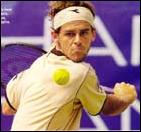
Often you'll see a hybrid with the feet, which I call disparate feet. One foot's pointing one way, the other another. The back foot will be sideways, or parallel to the baseline, indicating the prior direction of movement, but the front foot will open remarkably to the ball and may even point perpendicularly to the net. The pro does this to save the day. If not, by stepping sideways, the contact spot will lie outside the width of the feet, Step 3. But why not plan better so you don't have to complicate things at the end? [Wilander photo by Stephen Szurlej, Tennis Magazine, 06/96; Svereva photo by Michael Baz, Tennis Magazine, 12/91.] WATCH THE BALL THE SAME WAY Vision. On a backhand you'll turn your head to the side much more than on a forehand because either you turn too much anyway or your arm turns you when you take the racket back. The result is you won't time the ball well if your vision is impaired. You have to really work at seeing the ball well on the backhand, you have to open your own face to the ball. There's a popular and oft repeated tip that if your opponent could read your name printed on the back of your shirt you've achieved a good turn of the shoulders when taking the racket back. Well, you might really be turned, but with your head turned so much you won't be able to keep both eyes looking straight forward at the ball. What, then, to do? Why, develop the world's most flexible neck and shoulder, which Gustavo Kuerten remarkably displays on the right. Yikes! [Tennis Magazine, 12/00, photo by Brian Bahr/ALLSPORT.] The fact some pros appear to be doing this is a tribute to their body's flexibility, a flexibility developed since age 5 or 6 and enhanced over hours of practice. So don't turn your back. Instead focus on looking at the ball well, start the process of taking the racket back, and the turn will take care of itself.
BALANCE AND BODY WEIGHT SHIFT
If you keep your posture, balance, and stance like Brian Gottfried, chances are excellent your stroke will be strong. This requires you to lean back a little bit since the tendency on backhands is to keep your body weight on the front foot instead of the back one (again, the back foot rules). As stated in Step 5, balance is: "The torso and head are back when the body center moves first. The upper body appears to float above the lower body, with the lower body doing the most work. Unencumbered by having to counter any imbalance, the lower body and midsection can then provide maximum support to the arms. The end result is the strongest foundation possible when hitting or striking. Power."
A Revolutionary Tennis reader pointed out how that last statement clarified for him Don Budge's backhand stroke as seen on a tennisone.com video clip. The reader wrote how he felt Budge moved "too stiffly. Little did I know his floating, well-posture, erect vertical body movement was the key to his power not the diagonal arm movement he borrowed from his baseball experience." [Budge photo Tennis West, 5/21/98, photo International Tennis Hall of Fame.] Don Budge was a master. Even though on the tennisone.com clip he is not moving forward into the ball, he had great heart, great strength, great vision, and above all, a great gentility. With his thumb up the handle to produce his feared topspin, no wonder his follow through was so exaggerated. But his playing elegance indeed showed his mastery over his body's balance. Body balance is a simple thing, but too often you don't see this in how-to articles. And what you see, is what you'll do.
What's hard to do on a high backhand is NOT keeping the body away from the ball in a lateral direction (toward the side fence) but keeping the contact spot in the forward direction (toward the ball, or net) to allow the arm to unfold in that same direction as seen above (photo 5). We all tend to hit the high bouncer late because our eyes bring the ball in too deep before we think about hitting it. Hit the high bouncer sooner so it doesn't smother you. The solution on high balls is to get closer, laterally, as seen in Step 7, to keep the feet in the Forward Stance, and to reach out in front "more" in the direction of the ball (or net). BALANCE ON A BACKHAND On a forehand your arms spread out on either side of your body when you move and prepare the swing, sort of like you do when walking a line. But on a backhand you are imbalanced from the get-go. Both arms are on the same side of your body and you are constantly losing your balance. You lean over, bend at the waist, and get in a crouched position before swinging, all of which are counter productive. And you still lose it on the forward swing since the arm swings away from the body altogether. Even two handers easily lose their balance. What to do? Watch Gustavo Kuerten's magic. Yes, Kuerten seems imbalanced, his back seems to be "facing his opponent," and his back foot is turned too much to the side. It is a testament to Guga as the perfect student that he displays what the establishment has asked him to, and it is a testament to Guga's superb athleticism that he has developed techniques to help compensate for their inherent inconsistencies, one of which is his extraordinary neck and shoulder flexibility seen earlier above. [Tennis Magazine, 04/01, photo by Ron Angle.] Guga could remain imbalanced (leaning over/butt sticking out), but witness how his torso changes its position/angle over the lower body. At first the torso's a bit hunched over the lower body, a result of turn-turn-turn and disregard for the back foot, and then the torso rights itself above the lower body as the lower body's weight shifts onto his front foot. While Guga's lower body continues its forward journey into the contact his upper body has gone in the opposite direction to achieve balance. This is his compensatory technique, he pulls that torso back, and his head, too, before he swings the racket. Most players continue their hunched position into the shot, but Guga achieves a strong backhand by not doing so. Guga's upper body appears to float above the lower body, allowing the lower body to do the most work. Shifting your body's weight to empower the stroke means shifting it into the ball. This weight shift is linear, not rotational, for the same reasons as explained in Step 8, The Forehand, and Step 4, Your Power. This linear movement for your body's power source is a small movement, and as with all things small that make a big difference, it often gets lost in the shuffle. It isn't even recognized on the forehand side, where large body rotation is, which is why I guess the "lean into the ball" business developed for the backhand.
When the back leg swings around to embrace the contact spot it does not step more forward into the court than has the front foot. Guga's back leg is in the process of coming around during the the forward swing to help align his body's power (body center) with the hit, and this back leg does not wind up farther ahead of the front leg into the court after the hit. This swing-around of the back foot during contact when you're turned too much to the side prior to contact produces excellent results only when it's gentle and doesn't step toward the net and ahead of the front foot.
Federer Backhand Digitized Look The following link http://www.tennisone.com/club/lessons/braden/backhands/bh.free.php offers a free vidclip of Federer's and Clijster's backhand with the added instructional bonus of the players and strokes rendered in digitized form, or stick figures. This timely evidence of how-to regarding Federer's one handed backhand is offered by Vic Braden via the Ariel Performance Analysis System, or APAS, and we all should thank him for this. The photo sequence below taken off this vidclip shows how Federer's arm starts out bent, or folded across his stomach, and as the racket progresses to the contact spot the arm in effect unfolds, or unbends. In this example, as well as in many others, the arm clearly does not straighten to swing.
I know for a fact Vic would say he has groundstroke shots of Federer with a slight bend in the elbow as well as shots with a fairly straight arm, and that Federer's choice for these different approaches is an interesting question open for answer. I'm sure you all would add it depends on the situation, the shot, the spin, the time, those kinds of things, and you'd be absolutely correct, but the thing to note is we can have both endings, slightly bent or fairly straight, and yet each Federer backhand clearly begins with the bending, unbending arm. It is crystal clear here the arm is bent and unbends throughout the stroke. In no way does Federer straighten his arm to swing the racket down or up into the ball from the nadir of the swing, and neither does the butt cap go straight to the ball. This evidence confirms Revolutionary Tennis' description how the arm works to produce this stroke. But there is much more here to enjoy. When you view the clip for yourself you will see many things, including an interesting twisting of the racket, validating wrist movement. But a large gem shown in the stills above uncovers the cornerstone to all one handers, either flexible like Federer's or straightened like Robredo and Gasquet: the hand turning the racket face into the ball, no matter if you hit up the line or crosscourt. Photos 5 to 6 the body remains the same and the arm has moved imperceptibly, but what has occurred is the racket face has been turned into the ball (as pros call it). Dramatically. How?. The hand is responsible. The shoulder does not swing the racket, the arm does not swing the racket, it is the hand doing the heavy lifting throughout to ultimately turn the racket face into the ball. In this manner all one handers share the same element - the hand turning the racket head into the ball - and it's a process that's being setup from the beginning. Some may actually straighten the arm to swing the racket or straighten it halfway through the upward/forward swing itself while retaining stroke fluidity as you see in some pros (giving the false impression the butt cap or a straight arm plays a central role), but this places a heavier load on that final turn than does retaining flexibility in the arm. As a teacher I try to counsel arm flexibility instead of rigidity for this, and as a player I never try to straighten, or even think about straightening, the arm when swinging at the ball. If you have a severe backhand grip, like Robredo, or Kuerten, that is the hand is really behind the racket handle unlike Federer, this will force the arm to straighten in order to turn the racket face into the ball. Is this a better way to do it? In my opinion it's not, the demands and limitations for execution increase even more. If a student evolves into that grip position then it's inevitable the arm will straighten during the swing, but if that same student is looking to improve some advice would include either moving away from that grip and learn to use the wrist to achieve the same purpose or think about being a touch more flexible in thought with the arm instead of going rock-rigid-solid throughout the stroke.
|
||||
|
|
|
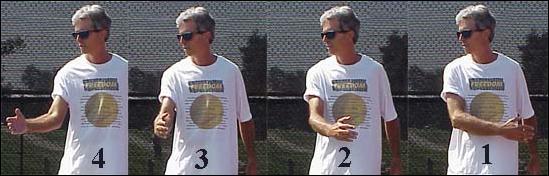 Photos 1-4, reading right to left, show how this works. In the "racket back" position, your hand is back by your rear pocket, yes, but what it noteworthy is that the arm is bent, or folded, across your stomach. (Two handers could straighten the front arm at this point, though it's best not to because of how it ends up.) Photos 2, 3, and 4 show how the arm "flexes" laterally around the elbow/biceps. The arm is folded across yourself or under your chest muscles in the backswing and then it unfolds for the forward swing.
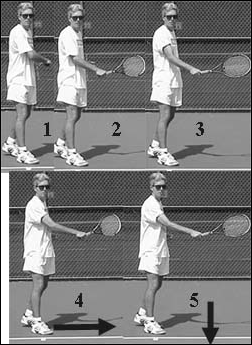 If you keep the elbow too close to your body, "elbow in," photos 2 and 3, the arm loses strength at contact for the one handed backhand, though for a two hander this is the position the front arm is in (photos follow). Photos 4 and 5 show how the elbow needs to extend a little from the body toward the side fence for a one hander while at the same time the stroke, or arm, as a whole unfolds forward out in front towards you, the reader (which is really saying towards the ball).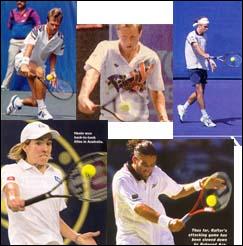
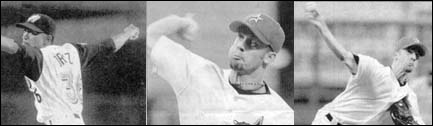 The arm appears straight in the photo on the left of baseball pitcher Ramon Ortiz as he winds up, and it appears straight on the far right of pitcher Roy Oswalt as he delivers to home plate, but the middle photo (Oswalt again) shows what the arm does in between those two positions. The arm isn't straightening to do its job, nor does the pitcher "straighten" the arm to throw.
 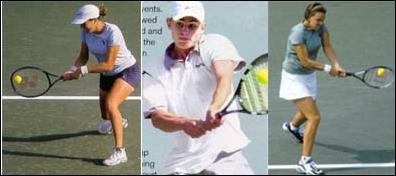 Two handed backhands don't have a problem with forearm "flexibility." The photos on the right of two handed backhands show how a two hander's front arm remains nicely bent at contact and closer to the body than for one handers. It doesn't make sense that the front arm would remain bent on a two hander yet go lock-arm straight on a one hander.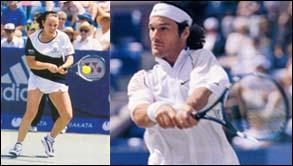
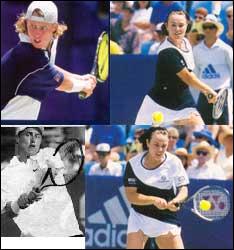 Two handers often seem to straighten their arms when they draw the racket back, but at contact the front arm is most definitely bent. This means both arms have "flexed," or bent, during the forward swing. Again, keep both arms "flexible" during the swing, avoid straightening either one. [ Hewitt photo top by Raveesh Whorra/NAV.TN, Tennis Magazine, 03/00, bottom by Richard Osborn, Inside Tennis, oct/nov 2001; Hingis cited above.]
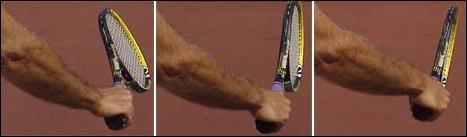 The wrist is the point of least resistance on all strokes, and on backhands it's especially weak because the hand breaks back, or inwards, against itself unlike forehands. To prevent this you could adopt an extreme eastern backhand, which is like holding your racket with a forehand grip and then using the same side of the racket facet to hit a backhand.
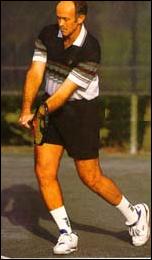 In Tennis magazine on the right, as an example, if you compare Jack Groppel's form with the
 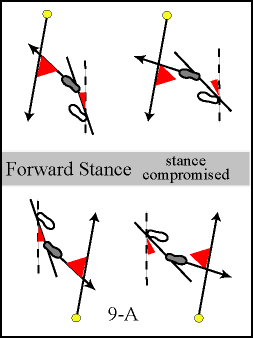 In diagram 9A, the left half shows what the Forward Stance looks like for a backhand, and the right half shows the common weakness for us all, stepping across. The bottom half is merely a flipped version of the top because you often see the pros from this perspective. When you step across the angle of the feet relative to the ball's flight line means the player has not been moving forward into the ball but off to the side. Without the body's momentum going into the ball, the contact will be less than stellar.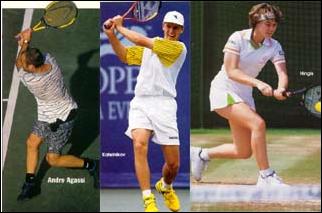
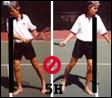
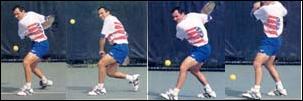 Look at the following four photos by the well intended and always on-the-money Nick Saviano. In photo 1, left to right, his feet look like they're in the Forward Stance, both pointing at and forward into the ball without stepping across. In photo 2 the front foot is definitely stepping across, in photo 3 it's not as pronounced but the feet are definitely disparate, and in photo 4 they're merely disparate though he's not stepping across so much, if at all. More important than Nick's stroking advice is the angle of his feet relative to each other and to the ball.
 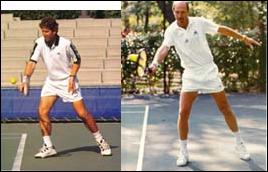 Another head to head example helps to show how this little thing with the feet slips by everyone. Both Brian Gottfried and Stan Smith extol the virtues of hitting the ball out in front sufficiently for a strong backhand. That part is true, but notice how little notice is given to the their foundation, their feet. Smith has his feet turned sideways, leaving the contact spot
 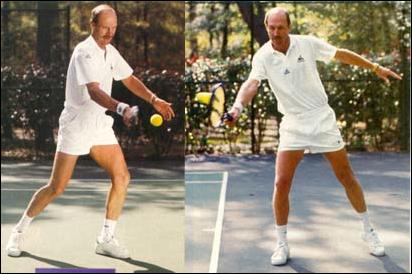 If you don't believe it, perhaps a comparison between Stan's forehand stance and his backhand stance will further advance the argument for symmetry. His forehand stance shows the Forward Stance, both feet are pointing at and into the ball, and great balance, but the symmetrical view isn't there on his backhand.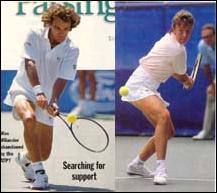
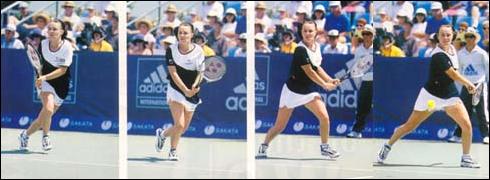 In the Hingis series right you can see how she counter-turns her head to her torso's own turning to clearly see the ball. Or you can say she keeps her head facing forward as her torso's turning.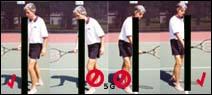
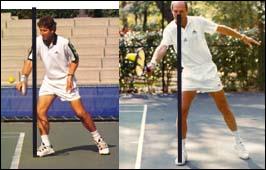 Here are the photos of Gottfried and Smith again with a line drawn showing how Smith's leaning over too much, he's off balance compared to Gottfried. The line has been placed right on the front toes.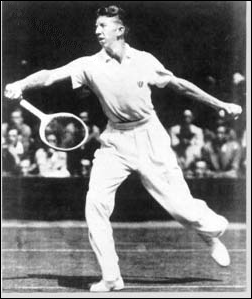
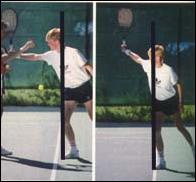 Dennis Van Der Meer instructs how to "step forward and lean into the shot" so you can "hit it a ton," Tennis magazine, 11/88, photos by Dom Furore. The model "leans" into the shot like Dennis wants him to, but he's way off balance in the first one, and still off balance in the second, which shows this little but most important detail that defines your body's strength has been completely ignored. The model's feet are right-on in the Forward Stance, but this seems to be merely a coincidence because the whole package isn't coming together.
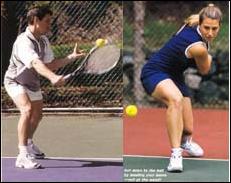 In the next photo, both the Van Der Meer student and Tennis Magazine's 101 tennis tips model are off balance as well. Though the feet are good on the left and passable on the right, the balance is off. On the left, ignoring the harmful imagery of the stick-straight arm, the right hip and buttocks stick out to the rear, and the head is turned way, way too much to the side. On the right, well, it's obvious.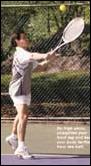
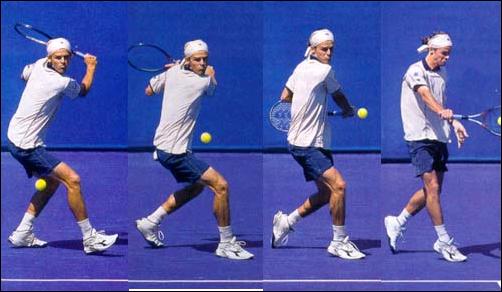
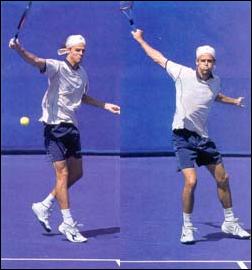
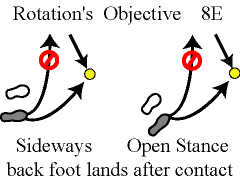 Guga's last two photos illustrate how to compensate when your body weight isn't going forward into the ball 100%. He is too turned, remember, his body center isn't going precisely forward into the ball/contact and he's going to have to re-align himself. How to? Rotation. As shown in 8E, body rotation is tolerated when the back leg swings around to embrace the contact spot and not when it swings around to the net.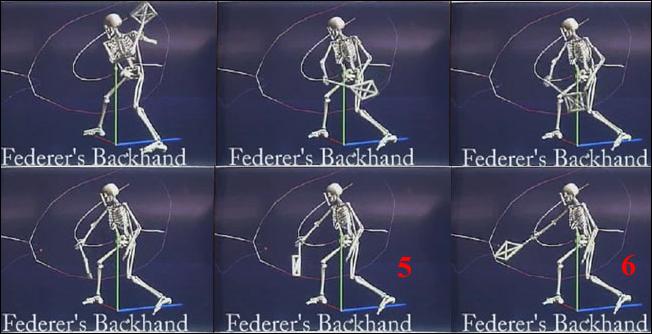



|
|
|
|
||||||||||||||||||||||||||||||||||||||||||||||||||||||||||||||
|
|
|
||||||||||||||||||||||||||||||||||||||||||||||||||||||||||||
























